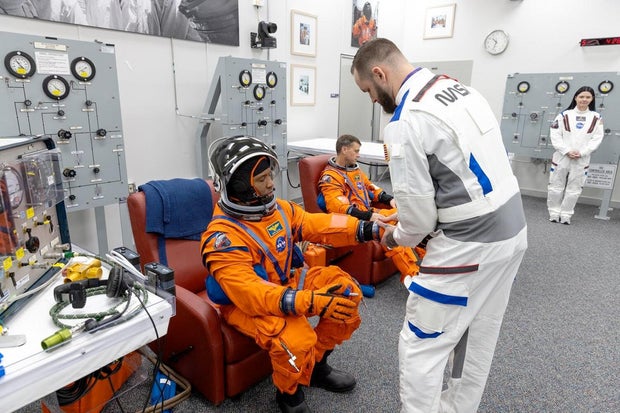
Four astronauts completed a countdown demonstration test inside the Vehicle Assembly Building in preparation for the Artemis 2 lunar flyaround, with commander Reid Wiseman calling the exercise overall successful despite stops and starts. Launch is tentatively targeted for early February (first opportunity Feb. 6) but faces a tight schedule — the SLS must be rolled to pad 39B in mid-January for a critical fueling test and the flight may slip to early March. Artemis 2 will perform a roughly 25-hour elliptical Earth orbit to validate life support, propulsion and rendezvous procedures before a free-return trajectory around the moon; the Orion capsule is built by Lockheed Martin. The mission is a milestone toward Artemis 3, now targeted for 2028, and underscores strategic competition as China aims for a crewed lunar landing by 2030.
Market structure: Artemis 2’s dress rehearsal is a near-term positive for prime contractors (Lockheed Martin - LMT, Northrop Grumman - NOC, RTX) because successful pad roll/fueling tests (mid-Jan roll; Feb 6 launch window) de-risks milestone payments and program cadence. Commercial aerospace (Boeing - BA) and small-cap space services see limited benefit; capability and cashflow accruals concentrate at primes, preserving their pricing power on NASA integration work over the next 12–36 months.
Risk assessment: Tail risks include a pad accident, major fueling anomaly, or Congressional funding re-prioritization that could push Artemis 2 beyond March or curtail HLS funding—each could remove ~5–15% of near-term revenue tail for suppliers. Immediate (days): headline-driven volatility around the mid-Jan roll; short-term (weeks/months): binary pad/fueling test outcomes; long-term (quarters/years): sustained re-rating tied to Artemis 3 timing (target 2028) and China lunar competition driving defense budgets.
Trade implications: Tactical alpha comes from event-driven size and volatility management: small directional exposure to LMT with asymmetric option structures ahead of the mid-Jan pad roll and a relative-long on defense primes vs commercial aero. Cross-asset: expect negligible commodity impact, slight tightening in long-dated Treasuries if Congress signals increased space/defense funding (basis points move possible if >$1bn incremental appropriations).
Contrarian: The market underestimates re-rating potential if Artemis 2 completes rendezvous tests cleanly—primes could see 5–10% upside rerating over 6–12 months as timeline credibility returns. Conversely, consensus under-prices political/regulatory risk: a high-visibility failure could trigger multi-quarter award slowdowns. Historic parallel: Apollo-era prime consolidation after early program success; outcome here will similarly concentrate wins at established primes.
AI-powered research, real-time alerts, and portfolio analytics for institutional investors.
Request DemoOverall Sentiment
mildly positive
Sentiment Score
0.25
Ticker Sentiment
