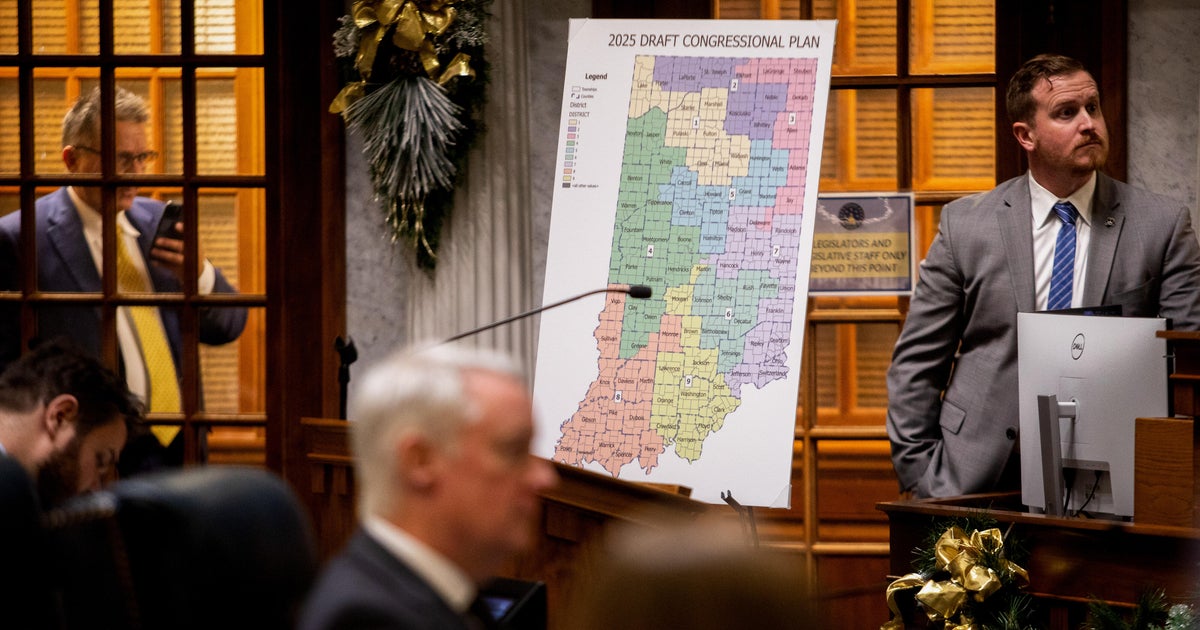
Indiana's state Senate will vote Thursday on a proposed mid‑decade congressional map designed to make all nine U.S. House districts Republican‑leaning — a plan that passed the state House 57‑41 and would break apart Democratic Rep. André Carson's Indianapolis district to dilute the city's Democratic electorate. Passage is uncertain: Republicans hold 40 of 50 Senate seats but the map requires 25 votes (with Lt. Gov. Micah Beckwith as tiebreaker), at least 12 GOP senators have publicly opposed it and several more are undecided, and the Senate president has signaled the votes may not be there. The push, driven by pressure from former President Trump, Vice President JD Vance and allied groups (Indiana Fair Maps has spent over $250,000 and an affiliated super PAC has pledged up to seven‑figure 2026 spending), is part of a national mid‑decade redistricting campaign ahead of 2026 and has already provoked threats against lawmakers, signaling heightened political and electoral consequences regardless of the vote's outcome.
Indiana's state Senate is scheduled to vote Thursday on a mid-decade congressional map that would reconfigure all nine U.S. House districts to lean Republican; the proposal passed the state House 57-41 and would substantially redraw Democratic Rep. André Carson's Indianapolis district. Passage is uncertain despite a 40-strong Republican majority in the 50-seat Senate because at least 12 GOP senators have publicly opposed the plan, several others remain privately undecided and Senate leadership has warned the votes may not be there, with the lieutenant governor as the potential tiebreaker.
The effort is being driven by outside pressure from former President Trump, Vice President JD Vance and allied groups; Indiana Fair Maps has spent more than $250,000 and an affiliated super PAC has pledged up to seven-figure 2026 spending to influence primaries and support pro-redistricting members. The debate has produced threats against lawmakers and mirrors a national mid-decade redistricting campaign cited in the article (Texas, California, Missouri, North Carolina, Maryland, Illinois), which raises reputational and operational political risk for state actors.
If enacted the map would aim to shift two seats toward Republicans and could materially change candidate lineups ahead of 2026, but intra-party fractures and public pushback create execution and electability risk. Market signals attached to the article rate sentiment as mixed and market impact as low (score 0.15), indicating limited immediate market reaction but rising political/regulatory uncertainty at the state and national levels that investors should monitor.
AI-powered research, real-time alerts, and portfolio analytics for institutional investors.
Request DemoOverall Sentiment
mixed
Sentiment Score
0.00
