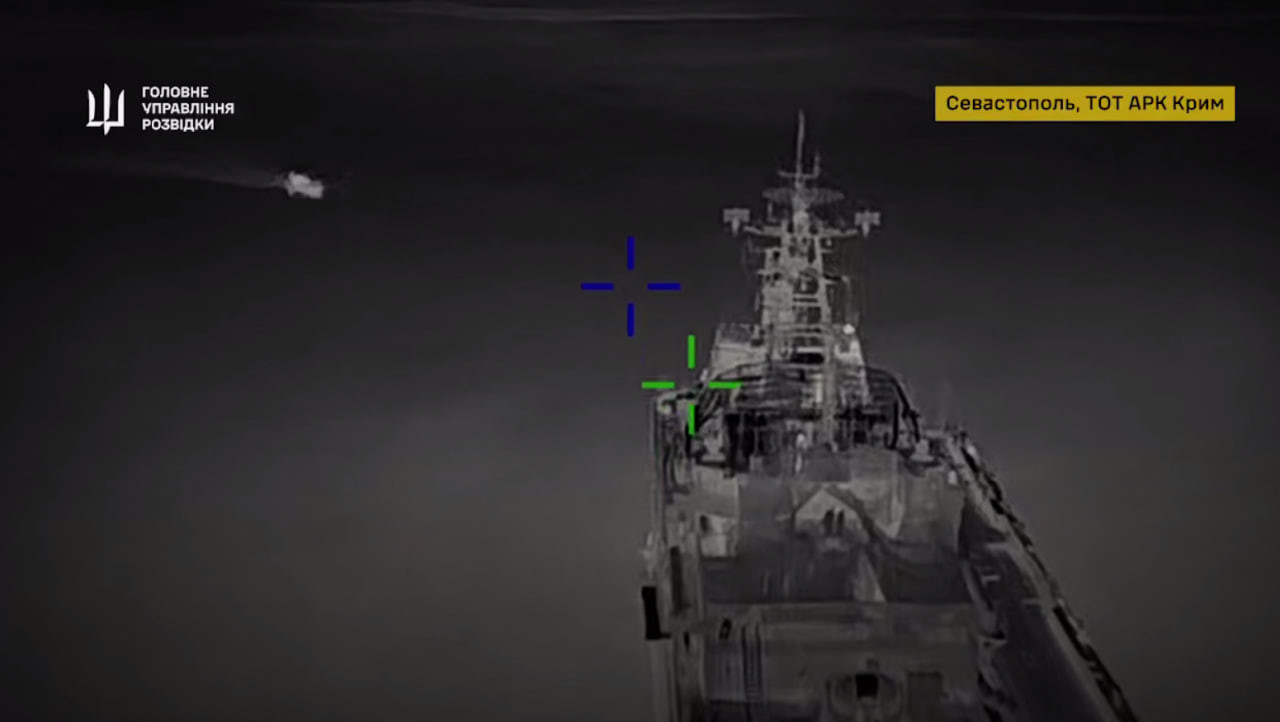
Ukraine’s HUR said its Prymary unit struck two Russian landing ships and a Podlyot-K1 radar system in occupied Sevastopol Bay overnight on April 18-19. The vessels targeted were the Project 775 Yamal, valued at more than $80 million, and the Project 1171 Nikolai Filchenkov, valued at over $70 million; the radar was estimated at about $5 million. The report underscores continued efforts to degrade Russian naval and air-defense capabilities in Crimea, though the damage could not be independently verified.
The market implication is not the headline damage, but the continued erosion of Russia’s ability to treat Crimea as a low-risk rear area. Repeated hits on fixed naval and radar assets force a higher air-defense density and more dispersion, which raises operating costs, reduces sortie tempo, and creates chronic maintenance drag that compounds over months rather than days. That is especially relevant for amphibious lift and coastal surveillance: even if replacement hulls or systems are not immediately scarce, the bottleneck becomes crews, basing flexibility, and confidence in the whole Black Sea logistics chain. Second-order winners are less the obvious defense primes and more the broader drone, ISR, EW, and counter-UAS ecosystem, because the marginal lesson is that relatively cheap precision assets can neutralize expensive, slow-moving platforms. If these strikes continue, Russia may be forced to harden or relocate assets farther from the frontline, lengthening supply lines and increasing fuel, transit, and wear-and-tear costs. The main loser is any scenario that relies on Crimea functioning as a stable staging hub; the more that assumption degrades, the more Russia’s Black Sea posture shifts from force projection to force preservation. The catalyst risk is asymmetrical escalation: Moscow can respond with stronger missile/drone salvos, but that does not necessarily restore the lost infrastructure advantage unless it can also suppress Ukraine’s strike network. The key reversal would be a meaningful improvement in Russian base defense, maritime dispersal, or battlefield air superiority over the next 1-3 months. Absent that, the trend is structurally negative for Russian naval readiness and mildly supportive for defense supply chains tied to low-cost autonomous systems and air-defense replenishment. Consensus may be overestimating the one-day tactical impact and underestimating the cumulative operational effect. A single landing ship or radar loss is not strategically decisive, but repeated attrition of high-value fixed assets can progressively narrow Russia’s options and increase the insurance premium on every Black Sea operation. The right lens is not immediate sunk cost, but whether Moscow is being pushed into a more capital-intensive, less flexible force posture that is harder to sustain through 2025.
AI-powered research, real-time alerts, and portfolio analytics for institutional investors.
Request DemoOverall Sentiment
neutral
Sentiment Score
-0.10
