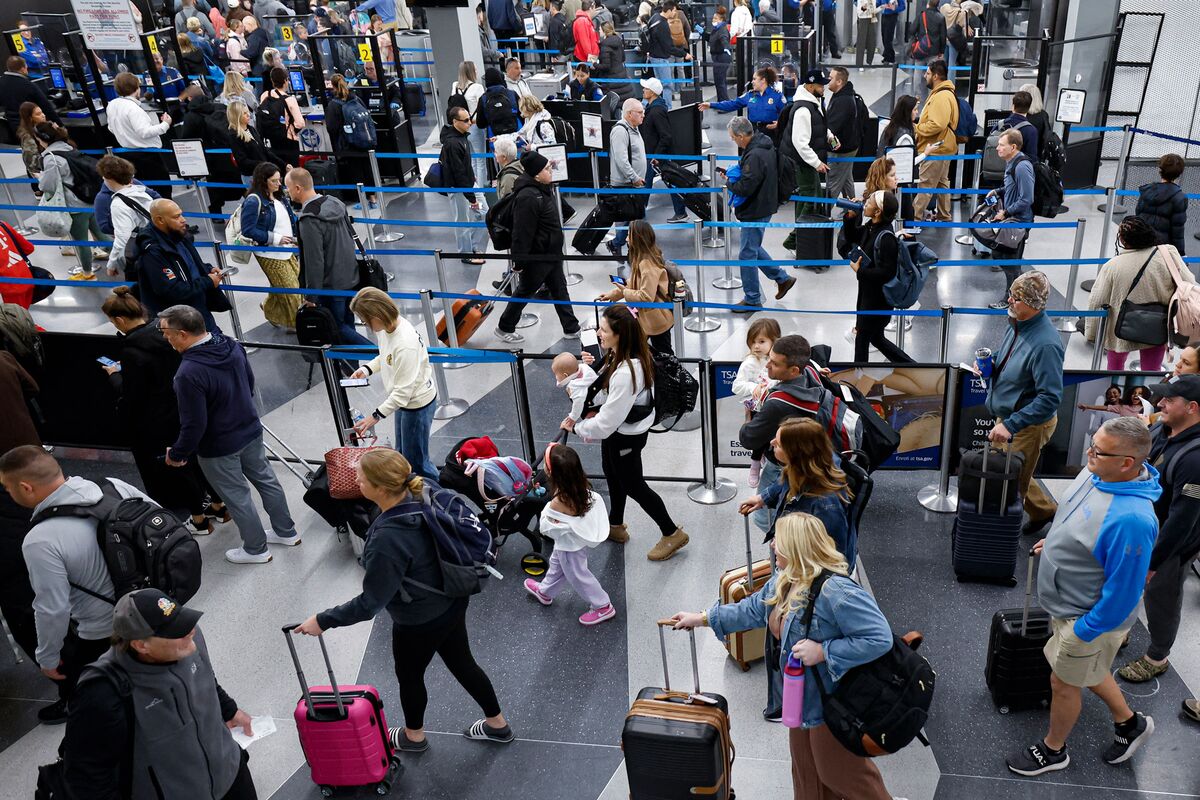
US airlines face what could be the busiest Thanksgiving on record, straining an aviation system still recovering from flight restrictions tied to the government shutdown. Acute air-traffic controller shortages, looming winter storms in the Pacific Northwest and Midwest, fuel-supply constraints, sporadic technology outages and the REAL ID rollout raise the probability of cancellations, delays and higher operating costs. These operational risks could pressure near-term airline revenues and ancillary travel services and create short-term volatility in travel-related equities; investors should watch cancellations/delay metrics, regional weather developments and fuel/tech disruption indicators.
Market structure: Peak Thanksgiving demand plus controller staffing shortages and regional weather creates a bifurcated market—incumbent hub carriers (DAL, UAL) can exercise pricing power on core routes while low-cost and regional operators (JBLU, LUV, REGS) bear disproportionate disruption risk. Supply/demand shows near-term capacity tightness (expected load factors +3–6% vs. Oct) pushing ticket yields higher but raising cancellation/rebooking costs. Cross-asset: anticipate 1–3% upside in jet-fuel crack spreads in the next 2–6 weeks, wider airline credit spreads (~20–50bp), and elevated equity implied vol on airline names and JETS ETF (ticker JETS).
Risk assessment: Tail risks include a multi-day FAA outage or major hub weather event causing systemic cancellations and regulatory fines—value at risk for large carriers could exceed 5–10% of quarterly EBITDA in a 3–5 day shutdown. Immediate window (days): booking/cancellation volatility; short-term (weeks): margin hit from fuel and rebooking costs; long-term (quarters): REAL ID frictions and ATC staffing could raise operating costs and require CAPEX. Hidden dependencies: refinery/pipeline constraints for jet fuel and airport staffing/IT resiliency.
Trade implications: Favor short-duration volatility trades in airlines (buy 30–45d put spreads on AAL and LUV sized to 0.5–1% portfolio risk each), paired with 2% longs in car-rental (CAR) and 2% longs in refiners (VLO or PSX) to capture jet-fuel-led margin tailwind. Buy a tactical 30–45d ATM straddle on JETS (size 0.5% portfolio) to capture event-driven IV spikes; use jet-fuel crack spread >$8/bbl or NOAA/FAA cancellations >20% at SEA/ORD as exit/trim signals.
Contrarian angle: The market may overprice systemic collapse risk; historical holiday-weather disruptions typically produce sharp but short-lived IV and fare recovery thereafter—selective long exposure to DAL/UAL for Dec–Jan (buy calendar call spreads if IV collapses post-holiday) can capture yield normalization while limiting downside if regulatory fines materialize.
AI-powered research, real-time alerts, and portfolio analytics for institutional investors.
Request DemoOverall Sentiment
moderately negative
Sentiment Score
-0.42
