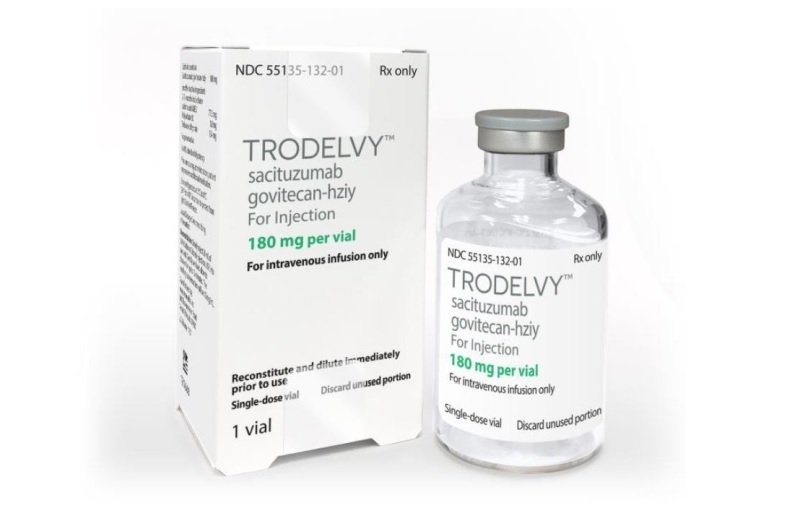
Gilead's Trodelvy, in combination with Merck's Keytruda, demonstrated a statistically significant 35% reduction in the risk of disease progression or death versus Keytruda and chemotherapy as a first-line treatment for metastatic triple-negative breast cancer (TNBC) with PD-L1 expression; the median progression-free survival was 11.2 months for the Trodelvy-Keytruda arm compared to 7.8 months for the chemo-Keytruda arm. While overall survival data is still immature, the Ascent-04 trial results, coupled with positive data from the Ascent-03 trial in PD-L1-negative TNBC, position Trodelvy as a potential new standard of care in first-line TNBC, though competition is emerging from drugs such as Kelun-Biotech’s sacituzumab tirumotecan.
Gilead Sciences’ Trodelvy, when combined with Merck & Co.’s Keytruda, has demonstrated significant efficacy as a first-line treatment for metastatic triple-negative breast cancer (TNBC) expressing PD-L1, potentially establishing a new standard of care. Data from the phase 3 Ascent-04 trial revealed a 35% reduction in the risk of disease progression or death compared to Keytruda plus chemotherapy, with the Trodelvy-Keytruda arm achieving a median progression-free survival (PFS) of 11.2 months versus 7.8 months for the control arm. An American Society of Clinical Oncology (ASCO) expert, Dr. Jane Lowe Meisel, not involved in the study, has characterized these results as "practice-changing." While overall survival (OS) data remain immature as of the March 3, 2025, cutoff, an early trend favored the Trodelvy-Keytruda combination with a preliminary 11% reduction in the risk of death, though this is based on only 26% of deaths required for final analysis and interpretation is complicated by 43% of control arm patients (81% of those receiving subsequent treatment) crossing over to Trodelvy monotherapy. This positive outcome builds upon Trodelvy's established efficacy in previously treated TNBC, where it is already the most-prescribed branded therapy in the second-line setting. Further bolstering Trodelvy's potential, Gilead also announced that the Ascent-03 trial, evaluating Trodelvy versus chemotherapy in first-line PD-L1-negative TNBC, showed a "highly statistically significant and clinically meaningful" improvement in PFS. Approximately 10% of U.S. breast cancer cases are triple-negative, with about 40% of these expressing PD-L1, indicating a substantial target patient population. The Trodelvy-Keytruda combination also showed a marginally higher tumor response rate (60% vs. 53%) but a markedly longer median duration of response (16.5 months vs. 9.2 months) compared to chemo-Keytruda, a critical factor given the aggressive nature of TNBC. Despite Trodelvy's current leadership, competition is intensifying. Kelun-Biotech's Merck-partnered sacituzumab tirumotecan (sac-TMT) showed a 70.7% objective response rate and a median PFS of 13.4 months in a phase 2 study for first-line TNBC in China, though experts urge caution in extrapolating these results. AstraZeneca's Datroway, partnered with Daiichi Sankyo, also has ongoing phase 3 trials with readouts anticipated.
AI-powered research, real-time alerts, and portfolio analytics for institutional investors.
Request DemoOverall Sentiment
strongly positive
Sentiment Score
0.80
Ticker Sentiment
