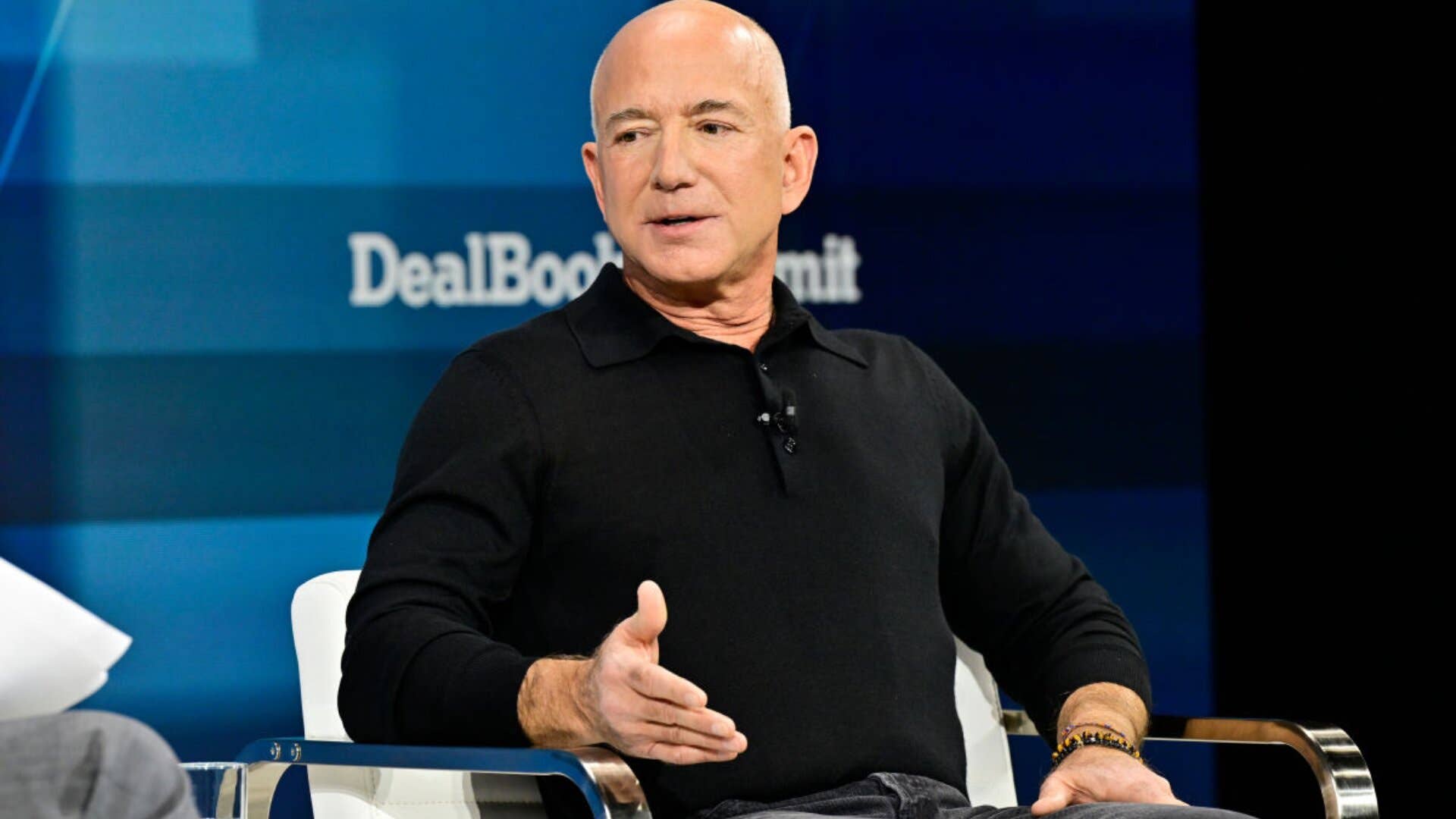
Jeff Bezos, a significant investor in AI, has warned of an "industrial bubble" in the artificial intelligence sector, drawing parallels to the 1990s biotech bubble where intense excitement funds both viable and non-viable ventures. Despite this caution regarding current valuations, Bezos remains bullish on AI's long-term technological advancements, believing the eventual breakthroughs will justify the investment frenzy, even if many firms fail. This assessment underscores concerns about the frothy AI market, which is projected to see $400 billion in infrastructure spending this year amidst questions of immediate returns and sustainable valuations.
Jeff Bezos sends blunt message on AI bubble Wall Street veterans remember the dot-com bubble like it was yesterday. The good times seemed like they would never end as markets experienced the longest period of economic expansion in U.S. history between the end of World War II and the year 2000. "From October 1998 onwards, markets cheered the seemingly endless IPOs of dot-com firms without paying much attention to the viability of their business models," Goldman Sachs says of the era. "A financial bubble was inflating." There were danger signs. In 1990, the value of stocks traded on the Nasdaq was 11% of the value of stocks traded on the New York Stock Exchange. By December 1999, that percentage had ballooned to 80%. The Nasdaq rose 86% in 1999 alone, peaking on March 10, 2000. And that's when the bubble burst. "As the value of tech stocks plummeted, cash-strapped internet startups became worthless in months and collapsed," according to GS. By October 4, 2002, the Nasdaq had fallen 77% from its peak. So when Jeff Bezos, one of the world's wealthiest people, mentions the "B" word, markets tend to listen. Jeff Bezos calls out "industrial" AI bubble Amazon founder Jeff Bezos is heavily invested in artificial intelligence. Earlier this year, Bezos' family office, Bezos Expeditions, invested $72 million in Amsterdam-based AI company Toloka. And last year, Bezos was one of the prominent investors in a $400 million funding round for Physical Intelligence, a robot startup that also counts OpenAI as an investor. Despite his ties to the industry, Bezos isn't blind to the runaway valuations that have become commonplace. “When people get very excited, as they are today about artificial intelligence for example ... every experiment gets funded, every company gets funded, the good ideas and the bad ideas,” Bezos said on Friday at Italian Tech Week in Turin, Italy. “Investors have a hard time in the middle of this excitement distinguishing between the good ideas and the bad ideas.” Despite the tepid estimation of the market's current state, Bezos is still bullish on the AI sector. Bezos sees what's happening now as an "industrial bubble" more similar to the biotech bubble in the '90s. While many investors lost a lot of money to that bubble, "we did get a couple of lifesaving drugs," he said. So even if many AI firms with billion-dollar valuations fall by the wayside, in Bezos' mind, the technological advancements will be well worth it, even if some investors are wiped out by the bubble bursting. Signs of an inflating AI tech bubble For those paying attention, Bezos' comments Friday come as no surprise. The AI industry is extremely frothy, thanks to hundreds of billions of dollars in investments, and there is little chance of an industry return on investment anytime soon. "The numbers just don't make sense," according to industry watcher Derek Thompson. "Tech companies are projected to spend about $400 billion this year on infrastructure to train and operate AI models. By nominal dollar sums, that is more than any group of firms has ever spent to do just about anything," he said. "The Apollo program allocated about $300 billion in inflation-adjusted dollars to get America to the moon between the early 1960s and the early 1970s. The AI buildout requires companies to collectively fund a new Apollo program, not every 10 years, but every 10 months." Total AI expenditures are projected to exceed $500 billion in 2026 and 2027. Jeff Bezos, a significant investor in the artificial intelligence sector and founder of Amazon, has issued a stark warning, characterizing the current market as an "industrial bubble." This assessment draws a parallel to the biotech bubble of the 1990s, where widespread investor excitement led to the funding of both viable and non-viable companies, making it difficult to distinguish between them. Despite this caution on valuations, Bezos remains bullish on the long-term transformative potential of the technology, anticipating that significant breakthroughs will emerge even if many firms fail and investors incur losses. The scale of the current investment cycle is substantial, with projected infrastructure spending reaching $400 billion this year and expected to exceed $500 billion annually by 2026. This level of expenditure, compared in the article to a recurring Apollo-sized program, is occurring with little prospect of an industry-wide return on investment in the near term, reinforcing the view of a "frothy" market where valuations may be detached from fundamental viability.
AI-powered research, real-time alerts, and portfolio analytics for institutional investors.
Request DemoOverall Sentiment
moderately negative
Sentiment Score
-0.30
Ticker Sentiment
