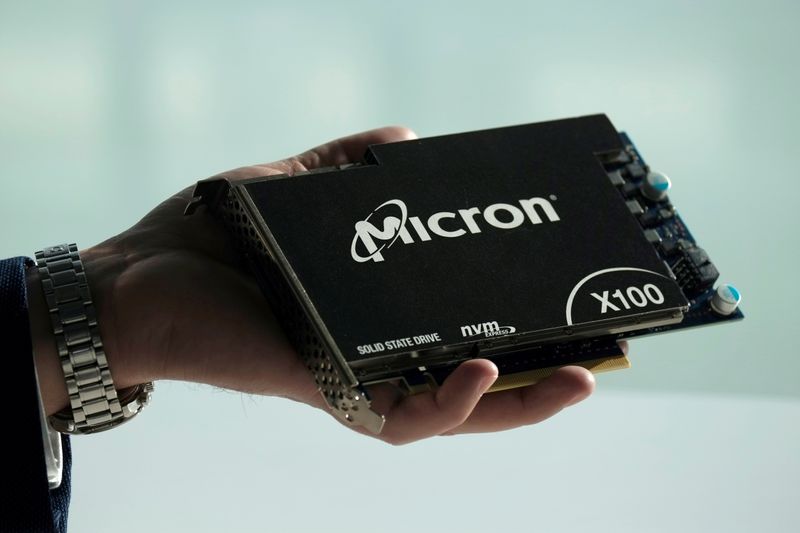
Micron executive Michael Charles Ray sold 7,001 shares for about $4.06 million at $511.64-$544.73 under a Rule 10b5-1 plan, leaving him with 67,227 shares. The article also highlights positive business momentum from Micron's 245TB 6600 ION SSD launch and bullish analyst actions, including TD Cowen's $660 target and DA Davidson's $1,000 target. However, the stock is already trading near its 52-week high of $651.74 and is described as overvalued relative to fair value.
The setup is constructive for memory, but the more important signal is that pricing power is starting to migrate from cyclical optimism to structural scarcity. When hyperscalers are forced to extend server life and buy fewer replacement systems, the constraint shifts downstream into memory intensity per box rather than unit volume; that is favorable for the highest-quality suppliers because it makes supply discipline more valuable than pure shipment growth. The second-order effect is that NAND and DRAM buyers will likely lock in longer-duration agreements to reduce allocation risk, which should compress spot volatility and improve margin visibility into 2027. The market is still underestimating how concentrated this trade has become around AI capex and inventory normalization. If enterprise and non-AI refresh cycles stay deferred, memory demand can remain tight even if headline server shipments soften, because AI clusters consume disproportionate amounts of high-value memory and storage. That creates a winner-take-more dynamic for the names with the strongest product mix and least need to chase volume, while smaller or more levered peers face a nastier mix of flat units and still-elevated expectations. The insider sale is not a bearish signal by itself given the 10b5-1 structure, but it matters as a sentiment marker after a large run: upside from here likely needs either another leg of forecast revision or evidence that margins can stay elevated through the next supply response. The key risk is that the industry over-earns for 2-3 quarters, triggering capacity adds and a 2027 air pocket; historically, memory peaks break when lead times and contract terms stop tightening. On the other side, if hyperscaler procurement continues to prioritize AI infrastructure, the current move can persist longer than consensus expects. The contrarian view is that the market may be too focused on AI scarcity and not enough on substitution and elasticity: enterprise buyers can stretch refresh cycles, reconfigure workloads, and trade down on mix, which caps the medium-term TAM. That makes this less a pure momentum trade and more a relative-value expression on margin durability versus multiple expansion. In that framework, the best risk/reward is not chasing the most extended name, but owning the supplier with the cleanest earnings revision path while fading any over-enthusiastic valuation on the beneficiaries with the most crowded positioning.
AI-powered research, real-time alerts, and portfolio analytics for institutional investors.
Request DemoOverall Sentiment
mildly positive
Sentiment Score
0.35
Ticker Sentiment
