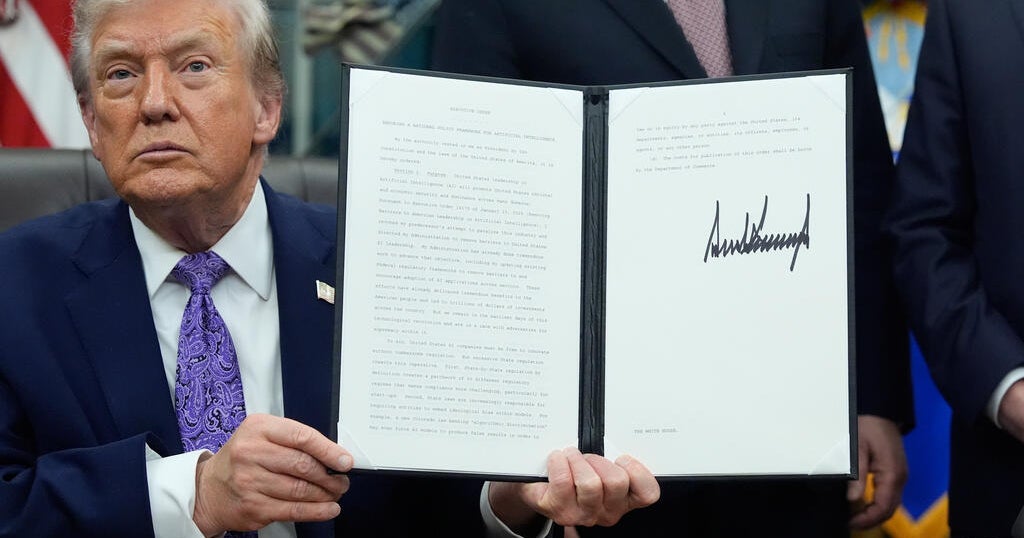
President Trump signed an executive order directing the attorney general to form a task force to challenge state AI laws, ordering Commerce to identify problematic regulations and threatening to withhold federal broadband and other grants from states that impose what the administration deems “excessive” AI rules, arguing a patchwork of 50 state regimes would stifle U.S. competitiveness with China. Administration adviser David Sacks said the push will target only the most onerous state measures, while critics from both parties and civil liberties groups — including Gov. Ron DeSantis and Sen. Ed Markey — denounced the move as federal overreach and a subsidy to Big Tech; four states (Colorado, California, Utah and Texas) have already enacted AI-related laws addressing transparency, data limits and bias risks. The order sets up an imminent federal–state policy clash with material implications for compliance costs, innovation dynamics (especially for startups), and the pace and shape of U.S. AI governance.
President Trump signed an executive order directing Attorney General Pam Bondi to form a task force to challenge state AI laws, instructing the Commerce Department to identify “problematic” regulations and threatening to withhold federal broadband and other grant funding from states that enact what the administration deems excessive restrictions. Administration adviser David Sacks framed the move as narrowly targeted at the most onerous state measures while preserving limited protections such as "kid safety," signaling an intent to limit state-level fragmentation rather than impose a new federal regulatory regime.
Four states—Colorado, California, Utah and Texas—have already enacted AI-related statutes addressing data collection limits, transparency and risk assessments for discriminatory outcomes; the article highlights AI’s use in consequential decisions (hiring, lending, housing, medical care) and cites research showing bias risks that motivate state action. Supporters of federal intervention argue a patchwork of 50 state regimes would stifle innovation and advantage China, while critics from both parties, including Gov. Ron DeSantis and Sen. Ed Markey, call the order federal overreach or a subsidy to Big Tech.
The policy creates a near-term federal–state clash that raises compliance uncertainty and potential legal challenges, with the signals indicating mildly positive market sentiment (sentiment_score 0.25, market_impact_score 0.35) reflecting a modestly bullish view toward incumbent tech firms. Key risks for investors are regulatory litigation, shifts in federal leverage via grant funding, and political pushback that could alter which market participants benefit if federal preemption or selective enforcement takes hold.
AI-powered research, real-time alerts, and portfolio analytics for institutional investors.
Request DemoOverall Sentiment
mildly positive
Sentiment Score
0.25
