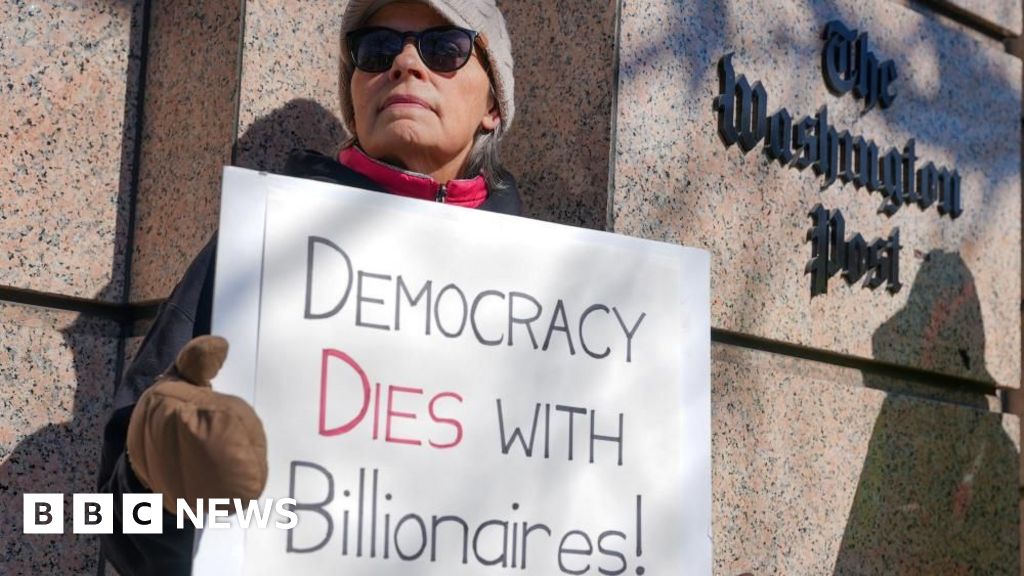
Washington Post CEO Will Lewis resigned days after overseeing a workforce reduction that cut roughly one-third of staff, including the paper's entire Middle East team and its Kyiv-based Ukraine correspondent; CFO Jeff D'Onofrio will serve as acting publisher and CEO. Lewis, appointed in 2023 to help reverse financial losses, leaves amid protests, subscriber defections tied to editorial shifts under owner Jeff Bezos, and heightened operational retrenchment that could pressure the paper's revenue profile and strategic direction.
Market structure: Short-term winners are rival national digital newsbrands (NYT) and distribution platforms (GOOGL, META) that can capture subscribers/traffic abandoned by the Post; losers are legacy local/foreign-news suppliers and the Post itself (private) with immediate reputational and coverage gaps. Expect competitors to be able to capture low-single-digit percentage points of national political/international-news subscribers within 6–12 months and modestly reprice ad inventory (higher CPMs for outlets with stronger original reporting). Cross-asset impact is likely muted: negligible credit stress for AMZN but possible transient option/FX flows if headlines broaden; bond markets unaffected absent corporate action.
Risk assessment: Tail risks include advertiser boycotts or a broader subscriber exodus causing a 10–20% revenue shock to the Post (low probability) and reputational spillover that nudges concentrated-owner scrutiny of Amazon (AMZN) causing a 1–3% equity wobble. Immediate (days) risk is headline volatility and protests; short-term (weeks/months) is subscriber churn and ad reallocation; long-term (quarters) is structural audience migration and potential M&A or asset-sale scenarios. Hidden dependencies: Bezos’s editorial decisions are an idiosyncratic governance risk that can rapidly change subscriber elasticity and trigger second-order advertiser reactions.
Trade implications: Construct a modest asymmetric book: establish a 1–2% long position in NYT (NYT) over 3–9 months to capture potential subscriber inflows and buy a 6‑month 15% OTM call for ~0.25–0.5% notional as leverage; overweight GOOGL/META by +1% each (ad-share beneficiaries) through cash longs. Implement a defensive AMZN hedge: buy a 3‑month put spread 7.5% OTM (size 0.5% NAV) to protect vs a sentiment-driven 3–5% drawdown. Reduce legacy-media exposure (NWSA/GCI) by 25–50% over 2–6 weeks.
Contrarian angles: The market may overstate long-term damage — cuts could restore short-term profitability and stabilize the Post, which would blunt subscriber flight and remove a catalyst for public competitors. Historical parallel: previous owner-led restructurings (Post under Bezos earlier) initially triggered backlash but later stabilized subscribers; therefore watch for M&A or minority sale signals that would re-rate peers. Key thresholds to monitor: NYT monthly net adds >200k or Post subscriber losses >100k in a quarter, and any Bezos statements about divestment within 90 days.
AI-powered research, real-time alerts, and portfolio analytics for institutional investors.
Request DemoOverall Sentiment
strongly negative
Sentiment Score
-0.65
Ticker Sentiment
