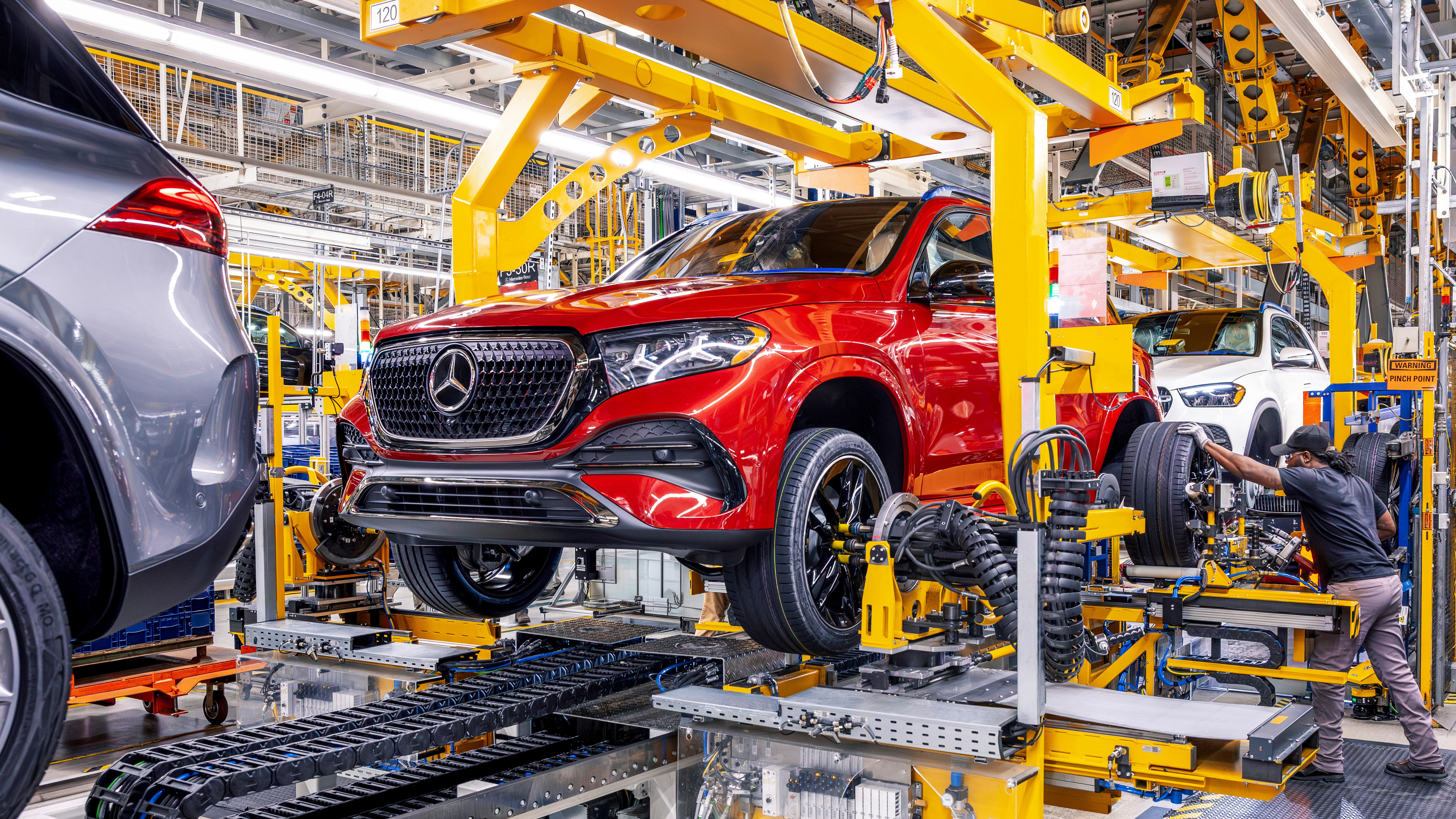
Mercedes is investing $4.0 billion to expand its Alabama plant to boost U.S. production and reduce its tariff burden. The move should improve supply-chain resilience and lower import-related costs for U.S.-bound vehicles, supporting margins and competitiveness in the world’s largest new-vehicle market. This is a material capex commitment likely to be positive for Mercedes’ U.S. operations and could modestly benefit the domestic supplier base.
Shifting final assembly and supplier footprints toward North American production is a latent lever that changes unit-level economics more than headline capex figures imply. For a mid-lux EV priced around $55–70k, unlocking eligibility for the full clean-vehicle credit and capturing additional domestic-sourcing premiums can improve net realized price by roughly $4k–9k per vehicle (7–12% of price), meaning a 100k annual-volume program can translate into $400M–$900M of incremental annual gross margin to OEM + suppliers combined once battery/content thresholds are met.
The incremental demand for locally sourced modules (electronics, chassis, seating, wiring harnesses) shifts revenue pools toward Tier-1s with North American footprints; a conservative throughput estimate is $1.0–2.5k of incremental domestic supplier content per car, implying $100M–$250M added annual revenue for suppliers per 100k vehicles produced, concentrated in connectors, ADAS, and thermal systems. This creates a multi-year re-rating opportunity for suppliers that can re-tool quickly (18–36 months) versus those with concentrated European capacity.
Key risks are timing and policy execution: meeting battery-component thresholds is technically hard and staged by calendar year, so full financial benefits are phased rather than immediate; a sales slowdown (6–12 months) or tighter battery-material bottlenecks would push payback out past 36 months. Also watch for retaliatory trade moves or revised tariff regimes that could reintroduce cross-border cost swings — these are low-probability but high-impact reversals that would compress realized margins and revalue the supply-chain winners established during the ramp.
AI-powered research, real-time alerts, and portfolio analytics for institutional investors.
Overall Sentiment
moderately positive
Sentiment Score
0.40
