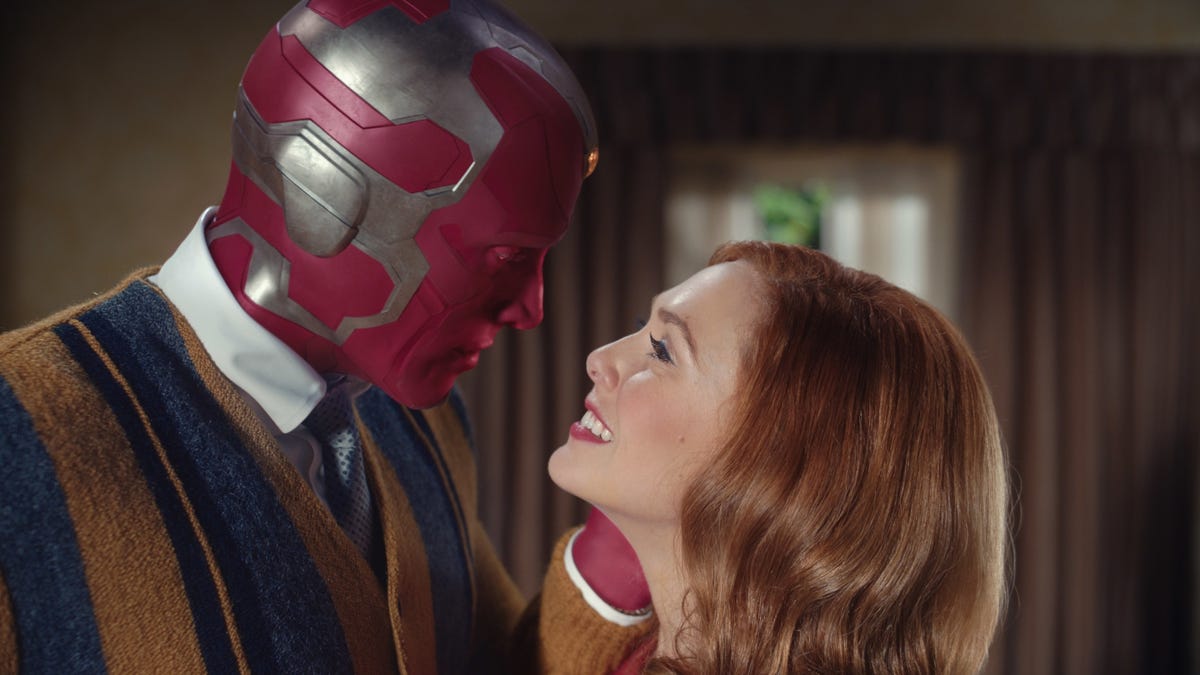
Disney announced that Marvel series VisionQuest will debut on Disney+ on Oct. 14, marking the conclusion of the WandaVision trilogy. The presentation also highlighted returning stars Robert Downey Jr., Tom Hiddleston, Paul Bettany, and James Spader, reinforcing Disney's Marvel content pipeline. The news is largely promotional and should have limited near-term market impact.
This is less about one title and more about Disney proving it can still manufacture event TV from an IP stack that the market already views as mature. The incremental value is not the series itself; it is the reinforcement of a franchise flywheel that drives cheaper customer acquisition, lower churn, and higher engagement around tentpole windows. In a streaming business where content spend is under scrutiny, a property that can be framed as a direct continuation of a prior hit reduces marketing waste and improves the odds of subscription retention around launch month.
The second-order read-through is competitive, not creative. Disney continues to show that legacy media can still outperform newer platforms on character recall and universe coherence, which matters when competitors are leaning on volume rather than canon. That supports a small but meaningful relative advantage in premium fandom monetization: merchandising, licensing, and theatrical halo value all become easier to extract when the audience is being reactivated rather than newly acquired.
The main risk is that the event is already well understood by the market, so the stock reaction may fade quickly unless management uses the launch to signal better-than-feared streaming profitability or ad-tier engagement. Over the next 1-3 months, the key variable is not viewership alone but whether this kind of release translates into lower churn or better ARPU enough to offset linear declines. If the title underperforms creatively or misses cultural resonance, it could reinforce the view that Disney’s franchise engine is still reliant on nostalgia rather than durable new-IP growth.
Contrarian take: the market may be underestimating how much optionality Disney has in reviving dormant characters at very low marginal cost relative to launching originals. If the company can keep converting old IP into recurring streaming events, the valuation gap versus pure-play streaming peers should narrow. The move is likely more durable as a fundamental signal than as a near-term catalyst, so any post-launch dip driven by “already priced in” sentiment could be a better entry than chasing the announcement.
AI-powered research, real-time alerts, and portfolio analytics for institutional investors.
Request DemoOverall Sentiment
neutral
Sentiment Score
0.15
Ticker Sentiment
