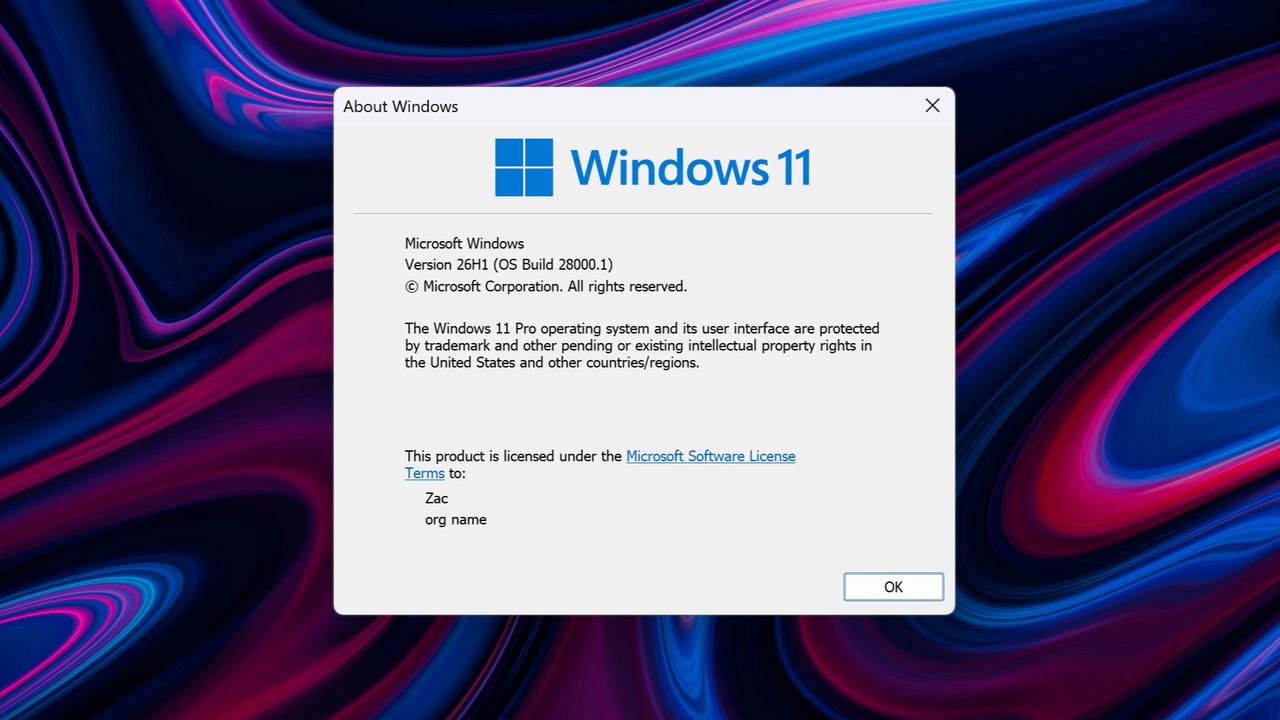
Microsoft released Windows 11 Canary Channel preview build 28020.1362, bringing features previously tested in Dev/Beta channels — including expanded Xbox full-screen support on handhelds, Click To Do context menu updates, enhanced Settings search, file share drag tray, Windows Studio Effects for external webcams, and File Explorer dark mode improvements. The piece highlights that the Canary channel (on the newer Bromine platform) is catching up to active development, with Bromine slated to ship as Windows 11 version 26H1 on Qualcomm Snapdragon X2 devices in 2026 and a wider 26H2 rollout later, a product roadmap item relevant to OEMs and investors monitoring Windows platform transitions.
Market structure: Microsoft (MSFT) and Qualcomm (QCOM) are the primary beneficiaries — MSFT regains feature parity across Insider channels (improves developer/QA feedback loop) and Bromine’s 26H1 debut on Snapdragon X2 (2026) creates direct silicon demand for QCOM. OEMs that commit early to Snapdragon X2 and handheld gaming makers gain optionality; incumbents in x86 client CPU (INTC, AMD) face incremental pricing/ASP pressure if Windows-on‑ARM gains share. Expect a multi-quarter adoption curve with measurable device shipments in 2H26–2027 before revenue meaningfully shifts OEM margins.
Risk assessment: Tail risks include execution failure of Windows-on‑ARM (software compatibility/emulation proving inadequate), Snapdragon X2 supply bottlenecks, or regulatory scrutiny of platform tie‑ups; any of these could wipe 20–40% of the optionality value embedded in QCOM. Immediate market impact is minimal (days); meaningful re‑rating likely in the 6–24 month window around 26H1/26H2. Hidden dependencies: OEM design wins, developer tooling, carrier support and battery/thermal performance on handhelds.
Trade implications: Direct plays — modest longs in MSFT and QCOM to capture platform transition optionality; consider 12–24 month call spreads (0.30–0.40 delta buys, sell ~25–35% higher strikes) to limit premium and target 20–50% upside. Pair trade — long QCOM vs short INTC to express ARM share shift; size small (1–2% net) and hedge with defined-risk options. Entry: stagger positions across next 3–6 months; increase only after concrete OEM design‑win announcements or QCOM shipment guidance beat (>+5M units year‑one).
Contrarian angles: Consensus underprices the convex optionality in QCOM from early Snapdragon X2 wins — upside is non‑linear if a few OEMs adopt broadly. Conversely, MSFT’s stock may already reflect platform diversification; upside from OS features is incremental, not transformational short‑term. Historical parallel: Surface/Windows‑on‑ARM initial failures then slow uptake — outcome depends on software compatibility improvements and OEM commitment. Unintended consequence: faster ARM adoption could trigger aggressive price cuts from x86 incumbents, compressing PC ASPs and creating a deflationary cycle affecting suppliers.
AI-powered research, real-time alerts, and portfolio analytics for institutional investors.
Request DemoOverall Sentiment
neutral
Sentiment Score
0.10
Ticker Sentiment
