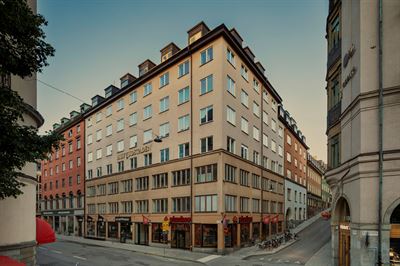
Hufvudstaden has signed a lease with Nordic financial adviser Max Matthiessen AB for approximately 4,800 sqm of office space across floors 1–6 at Kåkenhusen 40 (Brunnsgatan 3) in central Stockholm, with the tenant relocating in autumn 2026 and a dedicated Brunnsgatan entrance. The agreement leaves the property nearly fully let, improving Hufvudstaden’s occupancy profile and suggesting a modest uplift to future rental income and asset utilisation, although no rent or financial terms were disclosed.
Market structure: The lease of ~4,800 sqm to Max Matthiessen materially raises occupancy for a central-Stockholm prime asset (Hufvudstaden, HUFV.ST) and signals continued demand for top-tier CBD offices despite hybrid work narratives. Winners are prime CBD landlords (HUFV.ST, FABG.ST, CAST.ST) and service-providers (fit-out contractors, elevator/energy retrofit firms); losers are secondary/suburban office owners (KLOV-B.ST, KLED-B.ST) who face relative pricing pressure and higher vacancy. Credit spreads on Swedish prime CRE bonds should tighten modestly (5–15bp) if this deal is a trend, supporting shorter-duration corporate paper and mildly bullish SEK vs EUR (1–3% over 3–12 months).
Risk assessment: Tail risks include an accelerated structural decline in office demand (20–30% effective desk shrinkage in 2–5 years), sharp capex-to-compliance increases (retrofit costs >€200–400/sqm), or tenant insolvency; any of these could cut NAV by 10–25% for exposed REITs. Immediate risk is execution: interior adaptation delays or cost overruns over the next 6–12 months; medium-term (12–24 months) is interest-rate volatility driven by Riksbank moves; long-term (3+ years) is demand secular change. Hidden dependency: valuation hinges on rental reversion assumptions—if landlords assume <5% rent decline they’re vulnerable; monitor municipal permitting and energy-class requirements as catalysts.
Trade implications: Direct play: establish a tactical 2–3% portfolio position long HUFV.ST within 2–6 weeks, target +20% in 12–18 months, stop-loss at -8% to cap event risk. Relative-value: run a 1:1 pair long HUFV.ST / short KLOV-B.ST sized to neutral beta for 6–12 months to capture central vs peripheral re-letting spreads; trim if Stockholm prime vacancy falls below 4% or rises above 7%. Options: buy 9–12 month HUFV.ST calls (target strike ~5–10% OTM) with allocation 0.5–1% to asymmetrically capture upside from continued re-leasing and yield compression.
Contrarian angles: The market may underprice the resilience of prime CBD stock—historical parallels (post-2010 recoveries) show prime yields compressing by 50–150bp within 12–24 months when macro stabilizes. Conversely, consensus may understate retrofit/ESG capex; if capex per sqm > SEK 3,000–5,000, leverage-sensitive REITs could be repriced down 15–30%. Unintended consequence: concentration of premium tenants in a few landlords can create scarcity-driven rent inflation for prime space, benefitting well-capitalized names but increasing re-letting competition and churn for mid-tier owners. Monitor: Stockholm CBD vacancy, Riksbank rate path, and announced capex estimates over next 90 days for portfolio re-rating triggers.
AI-powered research, real-time alerts, and portfolio analytics for institutional investors.
Request DemoOverall Sentiment
mildly positive
Sentiment Score
0.32
