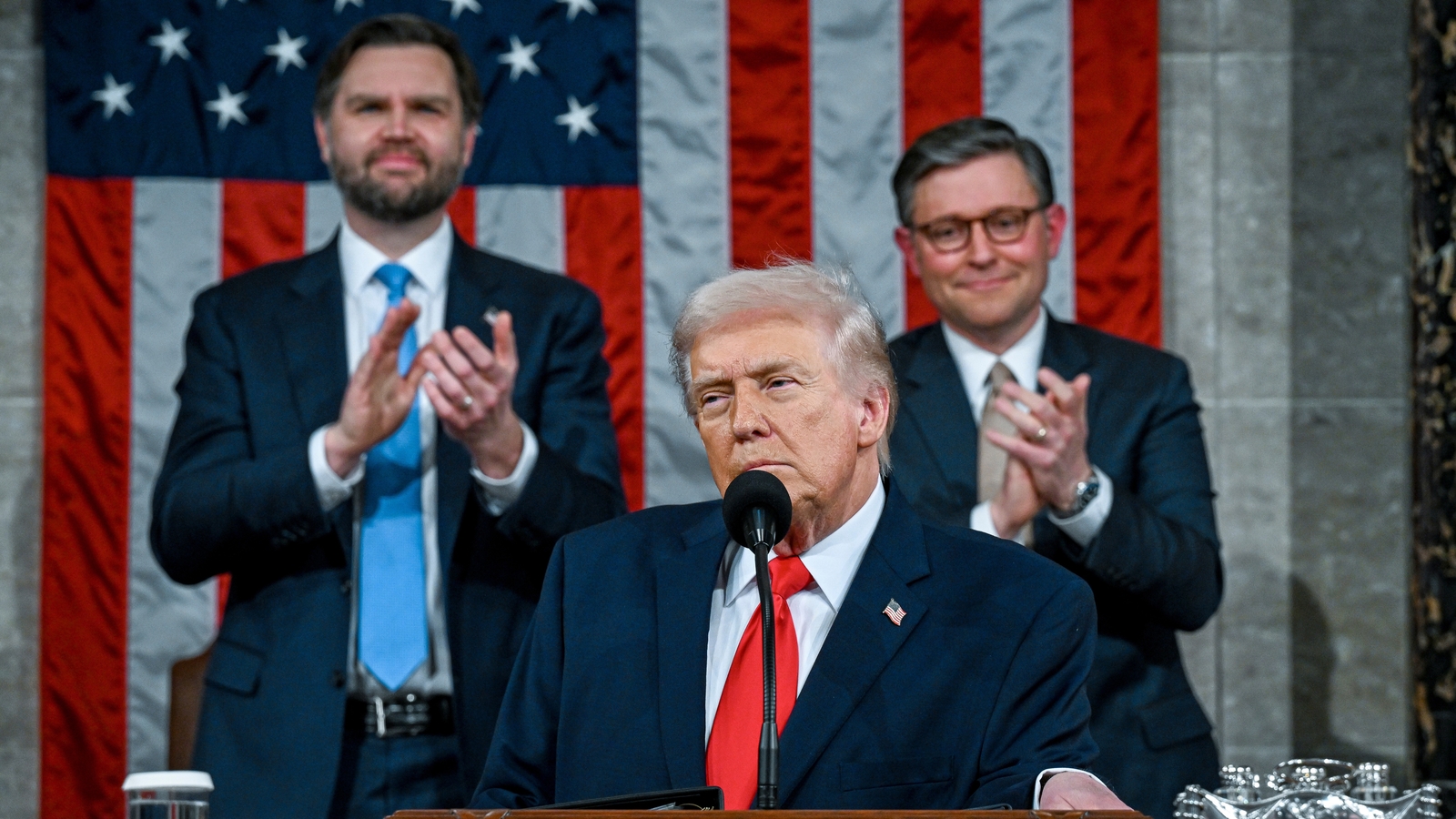
In his State of the Union, President Trump made broad economic and policy claims that ABC News fact-checked: border encounters fell from over 1.5 million in 2024 to roughly 28,000 in 2025 but were not zero; headline inflation cited fell from about 3.0% to 2.4%; energy prices rose 6.3% (Jan 2025–Jan 2026) and ground coffee prices are up 34% year-over-year amid tariff effects. The White House’s claim of $9.6 trillion in investments contrasts with the president’s unsupported $18 trillion assertion, and drug-price moves have produced targeted cash-price cuts for some medicines (e.g., Wegovy, Zepbound) while larger list-price reductions for drugs such as Eliquis (~50%) and Jardiance (~66%) are largely tied to prior policies like Medicare negotiation.
Market structure: Trump’s mix of tariffs, immigration enforcement and headline geopolitics reallocates profits toward domestic capital owners — domestic heavy industry, defense (RTX, LMT), energy (XOM/CVX) and data-center operators (EQIX, DLR) see pricing power; import-dependent retailers and consumer-goods makers (TGT, SBUX, PG) face margin pressure from higher input and food/coffee costs. Lower headline inflation (2.4%) supports longer-duration assets but is heterogeneous—energy and specific foodstuffs are rising, implying stagflation-like dispersion across sectors over 3–12 months.
Risk assessment: Tail risks include a sharp oil shock from Iran escalation (Brent +20%+ in 1–3 months), abrupt tariff/legal reversals that re-open supply chains, or a midterm political swing that changes regulatory plans. Immediate (days) volatility will be SOTU/CPI-driven, short-term (weeks–months) earnings-margin re-pricing, and long-term (quarters) realization of the $9.6–$18T investment claims; watch CPI, 10y yield moves >30bp, and Senate/House control polls as catalysts.
Trade implications: Favor convex trades—long duration treasuries (TLT) if 10y yield drops 30–50bp over 3–6 months, hedge equities with 3-month 5% OTM S&P puts ahead of midterms, and run relative-value: long COST vs short TGT for 3–9 months to capture pricing/membership resilience. Commodity/energy: establish tactical 3–6% long in XOM/CVX or Brent futures as a hedge for geopolitical oil upside; size small given political uncertainty.
Contrarian angles: Consensus understates persistent tariff-driven input-cost inflation and AI/data-center energy intensity; markets may be too complacent on CPI reacceleration risk (a 0.3–0.6% monthly CPI bump would reprice yields by 30–60bp). Historical parallel: 2018 tariff cycle compressed retailer multiples for 6–18 months — similar dispersion and pair-trade opportunities are likely now.
AI-powered research, real-time alerts, and portfolio analytics for institutional investors.
Request DemoOverall Sentiment
neutral
Sentiment Score
-0.05
