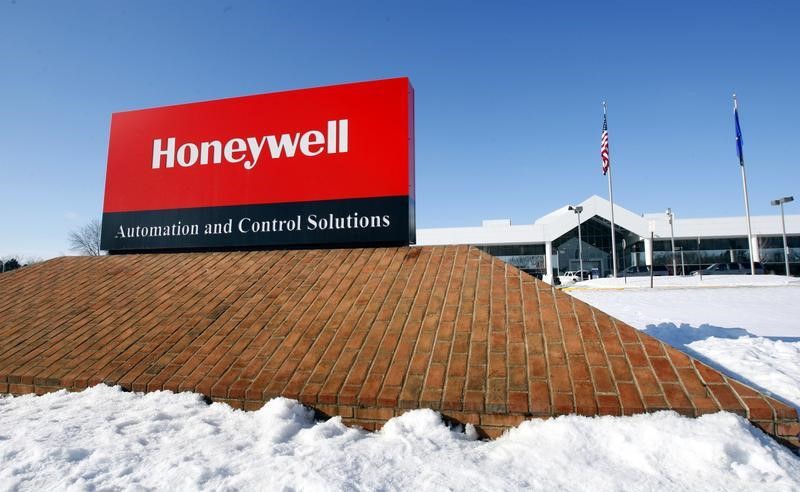
Honeywell beat Q1 adjusted EPS at $2.45 versus $2.32 consensus, but revenue missed at $9.14B versus $9.28B expected, driving shares down 5.5% premarket. The company kept full-year revenue guidance at $38.8B-$39.8B and EPS at $10.35-$10.65, but cut operating cash flow outlook to $4.4B-$4.7B from $4.7B-$5.0B. Orders rose 7% and backlog topped $38B, while geopolitical disruptions in the Middle East weighed on collections and shipments.
The market is pricing this as a classic quality-miss, but the more important signal is that the underlying demand engine is intact while cash conversion is getting noisy. That combination usually means the stock can re-rate again once investors stop anchoring on the guide-down and focus on backlog conversion; the risk is that the cash flow reset invites multiple compression for several weeks as PMs de-lever industrials with deteriorating operating leverage. The geopolitical disruption reads as transitory to the P&L but not to working capital, so the near-term penalty is likely more about collections and shipment timing than end-demand.
The second-order winner is anyone positioned for a cleaner post-spin asset story. Pulling stranded costs forward improves the optics of the Aerospace separation, which can unlock hidden value sooner than the market expected, while the Warehouse/Workflow divestiture removes a lower-growth, integration-heavy drag on margin quality. Competitors in automation and building technologies may see a brief share opportunity if customers use the temporary disruption to rebid projects, but the backlog data suggests demand is being deferred rather than lost.
The contrarian read is that the move may be too punitive relative to the guidance cut. The revenue midpoint vs. consensus gap is small, and the free cash flow range was preserved, which implies management still sees enough conversion efficiency to defend capital returns even with operating cash flow weaker. If collections normalize over the next 1-2 quarters and the geopolitical drag fades, the stock could recover quickly because the market is already discounting a more durable slowdown than the data actually implies.
AI-powered research, real-time alerts, and portfolio analytics for institutional investors.
Overall Sentiment
mildly negative
Sentiment Score
-0.15
Ticker Sentiment
