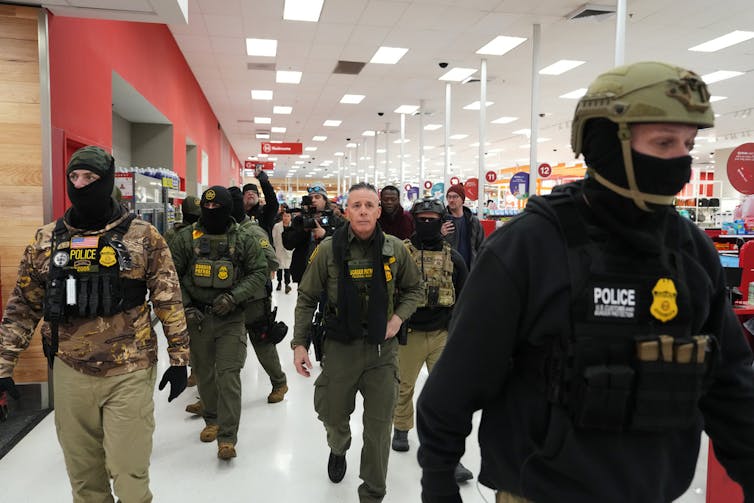
Federal immigration enforcement operations in the Twin Cities have directly hit local businesses and national retailers — some reporting revenue declines of 50%–80% and estimates that roughly 80% of businesses in impacted corridors have temporarily closed — prompting over 60 Minnesota CEOs (Target, 3M, UnitedHealth, etc.) to sign a cautious industry letter calling for peace and cooperation without assigning blame. The episode illustrates a chilling effect on corporate activism as firms prioritize de-escalation to avoid potential government retaliation, creating reputational and operational risk for affected retailers and raising governance tensions internally and with employees.
Market structure: Physical retailers with dense urban footprints (Target TGT, Best Buy BBY, regional restaurants) are immediate losers as localized enforcement can cut foot traffic 50–80% and may shave 0.2–0.5% off national comps for large chains if contagion hits multiple metros. Winners are defensive staples (General Mills GIS), e-commerce/last‑mile logistics and security/cyber providers; expect a 1–3% share shift toward online channels in affected corridors over 3–12 months, pressuring discretionary pricing power.
Risk assessment: Tail risks include federal escalation (nationwide enforcement or civil penalties) or punitive state retaliation (à la Disney) that could cause multi-quarter revenue disruption or contract cancellations—low probability but could inflict 10–20% valuation hits for targeted firms. Time horizons: immediate (days) = store closures and PR risk; short (weeks–months) = earnings misses, higher security/legal costs; long (quarters–years) = potential regulatory/legal restructurings and durable brand damage. Hidden dependencies include store-level labor availability, insurance costs and conditionality of government contracts (material for PLTR).
Trade implications: Tactical trades favor short-duration downside protection on exposed names and modest longs in defensive staples. Expect elevated implied volatility for TGT/DIS/PLTR into next 60–90 days around earnings and DHS/local policy announcements, creating opportunities for 3–6 month put purchases or bear put spreads and relative-value pairs (staples long vs discretionary short).
Contrarian angles: Consensus may overstate national contagion; big-box chains have diversified geographies and online channels — downside could be concentrated and mean-revert in 3–6 months if enforcement de‑escalates. Historical parallels (Disney, Bud Light) show acute market overreactions with partial recoveries; a calibrated short with defined risk or options collar avoids being whipsawed if policy risk abates.
AI-powered research, real-time alerts, and portfolio analytics for institutional investors.
Request DemoOverall Sentiment
moderately negative
Sentiment Score
-0.40
Ticker Sentiment
