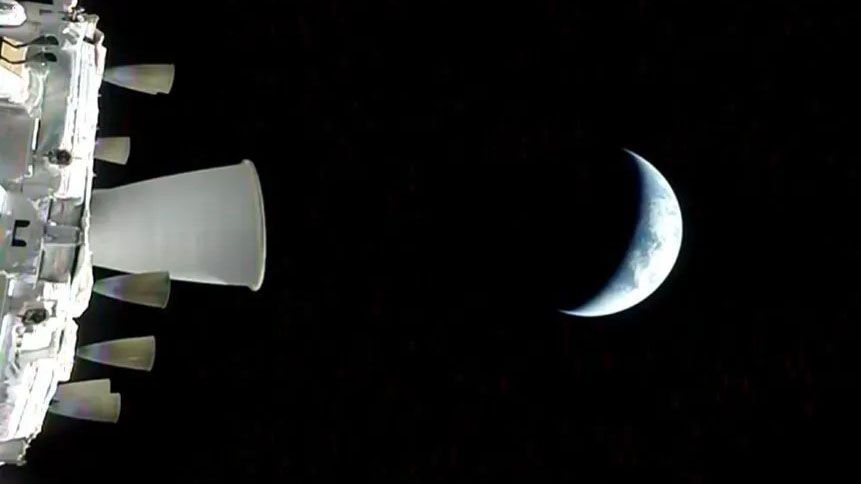
The translunar injection burn is scheduled for 7:49 p.m. EDT and will last 5 minutes 49 seconds, producing a Δv of 1,274 ft/s to send Artemis II’s Orion on a lunar flyby. Artemis II may set a new human distance record of ~252,799 miles (406,841 km) vs Apollo 13’s 248,655 miles; Orion has been in a ~46,000-mile apogee elliptical orbit for ~25 hours since the April 1 launch. Crew reported minor anomalies (a blinking fault light during an apogee-raise burn and a toilet issue) that mission control resolved; the translunar injection remains pending mission management approval.
A successful crewed translunar mission sharply re-anchors the political and procurement case for a sustained civil-space industrial base, converting episodic demonstration spending into multi-year follow-on opportunities for primes and niche suppliers. Expect a multi-year cadence of incremental contracts for avionics, radiation-hardened electronics, deep-space comms and life‑support subsystems; these are low-volume but high-margin and tend to re-rate balance sheets with 12–36 month revenue visibility rather than one-off aerospace service revenue.
Second-order supply-chain effects will favor firms with vertically integrated thermal/radiation shielding and propulsion test capacity because entry barriers (cryogenic test stands, contaminated-class facilities) prevent rapid competition; counterparties that outsourced those capabilities face longer lead times and higher capital intensity to compete. Conversely, commercial launch providers that underprice long-lead infrastructure may see slower demand for heavy-lift commercial substitutes if governments prefer proven prime contractors for human-rated systems, creating a bifurcation between government‑funded human spaceflight and commercial small-sat cadence.
Tail risks are mission anomalies or public-perception shocks that could trigger funding re-prioritization within 3–9 months; the larger reversal is a policy pivot toward purely commercial architectures which could siphon future awards away from legacy primes over 2–5 years. Short-term market moves will be volatile around mission updates — use a 48–72 hour window post-operations to avoid headline whipsaw, and size exposure to account for program timeline risk and political budget cycles that materialize annually.
AI-powered research, real-time alerts, and portfolio analytics for institutional investors.
Request DemoOverall Sentiment
neutral
Sentiment Score
0.00
