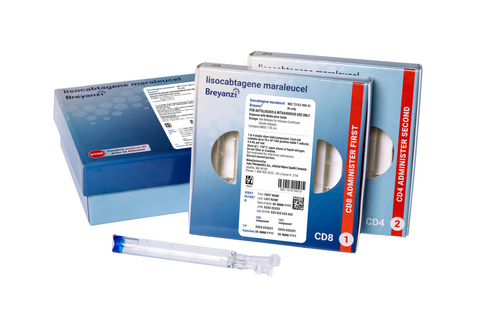
The FDA approved Bristol Myers Squibb's CD19-directed CAR T therapy Breyanzi (lisocabtagene maraleucel) for adult patients with relapsed or refractory marginal zone lymphoma after at least two prior systemic therapies, making Breyanzi the only CD19 CAR T product approved for five cancer types. Approval was based on the TRANSCEND FL MZL cohort (primary efficacy set n=66) which showed an overall response rate of 95.5% (95% CI: 87.3–99.1), a complete response rate of 62.1% (95% CI: 49.3–73.8), median duration of response not reached and 90.1% of responders maintaining response at 24 months; safety included any-grade CRS in 76% (Grade ≥3 in 4.5%) and neurologic events consistent with prior reports. The label expansion strengthens BMS’s cell therapy franchise and addressable market, though safety monitoring and prior accelerated-approval contingencies across indications remain relevant for commercial trajectory.
Market structure: BMY’s new MZL approval materially expands Breyanzi’s addressable population and makes BMY the CD19 leader versus GILD/KITE and NVS; expect an immediate 3–8% incremental TAM uplift for late-line indolent B‑cell NHL over 3–12 months but constrained by manufacturing throughput and payer coverage. Pricing power remains intact (single-infusion, high price-per-treatment), but net revenue realization will be paced by site capacity and prior authorization friction.
Risk assessment: Key tail risks are payer pushback (CMS/major private payers limiting coverage), a high‑profile safety event (CRS/secondary malignancy) or manufacturing failure causing recall — any of which could cut adoption by >40% vs base case. Near-term (days–weeks) risk is sentiment-driven; medium (3–12 months) risk centers on reimbursement and capacity; long-term (years) risk is competition from allogeneic/off‑the‑shelf CAR‑T or targeted small molecules.
Trade implications: Tactical long BMY exposure to capture label expansion is preferred; expect revenue recognition beginning within 2–4 quarters with ramp visible in successive quarterly calls. Use structured options (9–12 month call spreads) to cap premium; consider a small relative short vs GILD/KITE to express share capture while hedging broader CAR‑T sector moves.
Contrarian view: Consensus may overestimate immediate revenue because outpatient administration and site expansion take 6–12 months to materially increase capacity; upside is underappreciated if BMY secures favorable CMS coverage or scales manufacturing faster, in which case upside could exceed current estimates by >30% over 12–24 months.
AI-powered research, real-time alerts, and portfolio analytics for institutional investors.
Request DemoOverall Sentiment
moderately positive
Sentiment Score
0.36
Ticker Sentiment
