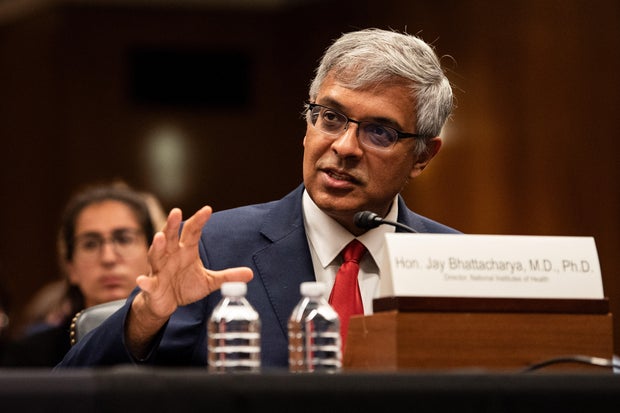
Key event: Acting CDC director Jay Bhattacharya will remain in charge until a permanent director is nominated and confirmed, with a White House/HHS-led search expected imminently. Staff reported heavy capacity and morale losses and fear that Schedule F could enable the firing of 'thousands' of federal workers, while hiring and leadership appointments face bureaucratic delays. Bhattacharya says leadership gaps are being filled and pledged to stabilize and depoliticize CDC operations.
A prolonged leadership and policy uncertainty at the federal public health level creates a multi-month regime shift: expect slower issuance of uniform national guidance and a patchwork of state-level responses that increases volatility in demand for diagnostics, surveillance services, and targeted public-health grants. Mechanically, fragmented guidance tends to raise private-sector testing and contract work by mid-single digits initially and can drive 10–20% incremental spend on state/federal contingency projects over a 3–9 month window as states and contractors fill gaps.
Loss of institutional knowledge from workforce churn is not just an HR problem — it lengthens procurement and grant cycles. A simulated 10–20% reduction in experienced staff translates into 15–25% longer processing times for research funding and data products, which benefits firms that can supply turnkey analytics, cloud hosting, or rapid procurement services on 3–18 month contracts.
Policy unpredictability materially raises tail risk for companies whose US market access depends on federal recommendations (vaccines, school health programs). Assign a 20–30% conditional probability over the next 12 months to scenarios that would depress adoption curves or complicate programmatic buys; that asymmetry justifies explicit hedges rather than broad de-risking of high-growth biotech exposure.
Conversely, expect a near-term procurement cycle for physical and cyber security and IT modernization following high-profile incidents; budgets here are lumpy but sizeable with a 6–18 month execution window. Winners will be firms with existing federal contracting platforms and supply-chain footprints that can deploy quickly; losers are niche service providers and suppliers reliant on steady federal contracting pipelines and predictability.
AI-powered research, real-time alerts, and portfolio analytics for institutional investors.
Request DemoOverall Sentiment
mildly negative
Sentiment Score
-0.25
