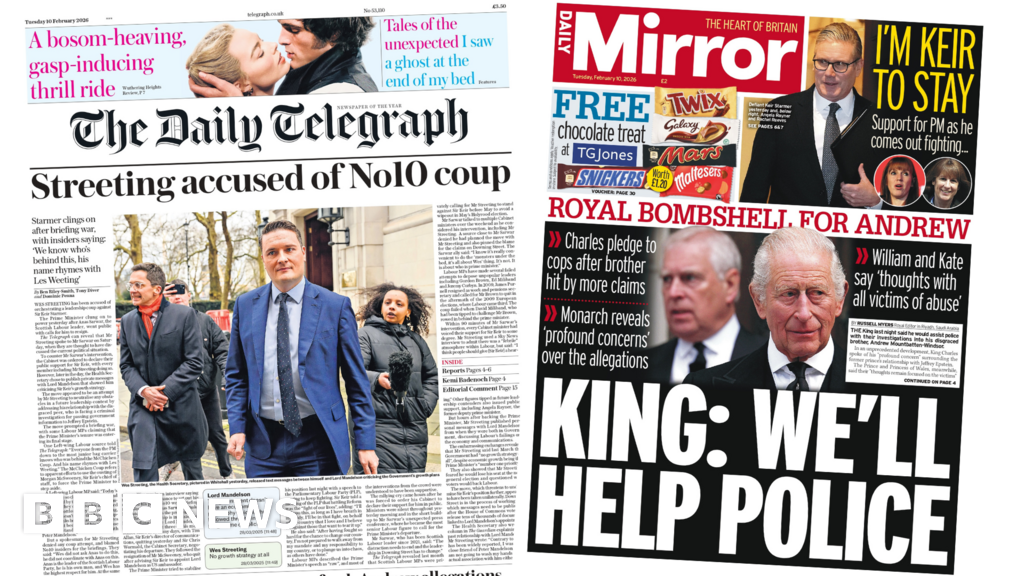
Prime Minister Keir Starmer is under intense domestic political pressure after Health Secretary Wes Streeting published texts with Lord Peter Mandelson, an action characterised by some as an attempt to neutralise rivals ahead of a leadership contest; Mandelson’s past ties to Jeffrey Epstein have been thrust back into scrutiny by newly released US justice department files. Concurrently, Buckingham Palace announced it will support police inquiries into allegations against Prince Andrew and reports surfaced of the US embassy denying visas to executives under an immigration clampdown, all of which raise near‑term political and reputational risk for the UK government and could increase short‑term market and policy uncertainty despite no direct fiscal or economic data being affected.
Market structure: Short-term winners are safe-haven assets and large-cap UK exporters; losers are domestically‑focused UK equities (FTSE 250/small caps) and consumer discretionary exposed to UK spending. Political/legal headlines boost traffic and ad revenue for tabloids and legal/security firms but are immaterial to broad corporate earnings; expect GBP weakness of 2–5% and a 20–60bp move in 10y gilts within days if headlines intensify.
Risk assessment: Tail risks include government collapse/early election (5–10% GBP fall, FTSE 250 down 10–20%, gilts volatile +/−100bps) and police/legal escalation implicating establishment figures which could lengthen uncertainty beyond one quarter. Immediate (0–7 days) volatility spikes, short-term (1–3 months) rotational flows, and longer-term (3–12 months) fiscal/BoE policy responses are the key horizons; catalysts are cabinet resignations, police statements, or forced testimony.
Trade implications: Implement relative-value trades: favor large-cap exporters and sell domestically exposed mid/small caps; use index futures and FX options for low-cost, quick adjustment. Volatility will be front-loaded — use 1–3 month 25-delta GBP puts for convex protection and pair trades (long FTSE 100 futures, short FTSE 250 futures) sized to portfolio risk budgets.
Contrarian angles: Consensus underprices the speed of mean reversion if Starmer stabilizes—sterling could rebound 3–5% within 2–4 weeks, squeezing one-way shorts; avoid levering directional bets and prefer option-defined risk or pairs. Historical UK political shocks (2016–2019) produced sharp intra‑quarter moves but median reversion within 6–12 weeks, so tranche sizing and tight stop/triggers matter.
AI-powered research, real-time alerts, and portfolio analytics for institutional investors.
Request DemoOverall Sentiment
moderately negative
Sentiment Score
-0.40
