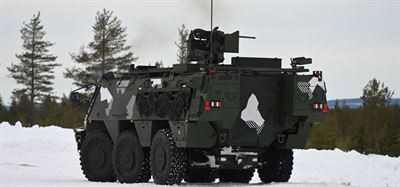
Patria has signed a contract with Kongsberg Defence & Aerospace worth approximately €140 million to supply PROTECTOR RS4 remote weapon stations for more than 300 Patria 6x6 armoured vehicles within the multinational CAVS programme, with assembly in cooperation with German industrial partners and deliveries scheduled 2026–2030. The order includes an additional Swedish requirement and RS4 subsystems for German-ordered variants (December 2025), reinforcing Patria/Kongsberg revenue visibility and standardising the RS4 across the CAVS fleet of seven member nations.
Market structure: Kongsberg (KOG.OL) is the direct winner as PROTECTOR RS4 becomes the de facto standard across >300 Patria 6x6 units (contract ~€140m, ≈€467k per-vehicle RS4/subsystems), providing multi-year revenue visibility 2026–2030. German assembly partnerships and Sweden’s add-on order broaden European supply-chain capture, boosting incumbents with local production (Rheinmetall-style primes) while niche RWS competitors face margin pressure and lost scale. The deal signals sustained defense procurement demand across CAVS members — expect visible backlog growth for European defense primes over the next 12–48 months.
Risk assessment: Tail risks include political procurement reversals (budget cuts or coalition shifts) and production/ITAR-style export controls that could delay deliveries; probability low-medium but impact large (revenue shift >20% for specialized suppliers). Immediate risk: announcement-driven knee-jerk moves in equities in days; short-term (months) risk: supplier bottlenecks (semiconductors, actuators); long-term (2026–2030) risks: cost overruns and integration penalties. Hidden dependency: contractual “mutual consent” for new CAVS entrants creates single-country veto points — a governance risk that can halt market expansion.
Trade implications: Favor long exposure to KOG.OL and selected European primes (RHM.DE) with a 12–24 month horizon; use defense ETF ITA for broader, liquid exposure (12-month overweight). Options: buy LEAP-like calls on KOG (12–18 month, ~25% OTM) sized to 50% of delta-equivalent equity exposure to control downside. Cross-asset: modestly positive for NOK and industrial credit spreads; consider small NOK long vs EUR (0.5% portfolio) as a tactical FX play.
Contrarian angle: The market may under-price governance friction — standardization can create single-source dependency and political leverage that caps pricing power over time. Historical parallel: European vehicle standardization (Boxer/Boxer-like programs) lifted subsystem vendors but compressed margin after price renegotiations; expect initial upside followed by margin normalization over 24–36 months. Unintended consequence: heavier scrutiny on offsets/local content could bifurcate winners — public-market investors should scale into confirmed follow-on orders, not initial press releases.
AI-powered research, real-time alerts, and portfolio analytics for institutional investors.
Request DemoOverall Sentiment
mildly positive
Sentiment Score
0.30
