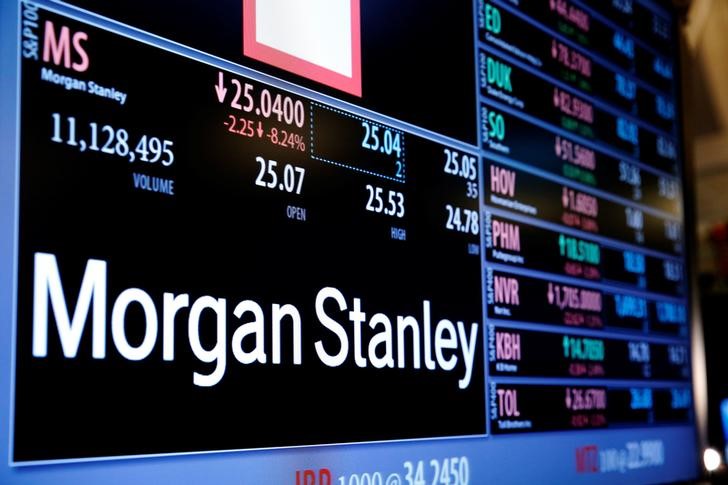
Morgan Stanley raised its Sunnova Energy price target to $494 from $453 while keeping an Equalweight rating, lifting the target multiple to 36x from 35x on updated 2027 EPS of $13.21. The stock trades at 42x the firm's 2027 EPS estimate, above the low-30s multiple for peers, and closed at $46.94, down about 7% year-to-date. The note is a valuation update rather than a fundamental catalyst, so the likely market impact is limited.
The key signal is not the small target revision itself, but the willingness of a high-quality industrial semi franchise to absorb a slightly richer multiple while the market is already rewarding AI infrastructure names. That keeps the valuation ladder intact for the AI hardware complex: when one bellwether can justify a premium on execution, it gives cover for investors to pay up for the next tier of names with stronger AI exposure and better earnings torque. The second-order effect is that capital likely rotates toward suppliers with clearer model-line visibility and away from “AI adjacent” stories that lack direct compute demand. The more interesting asymmetry is that the article implicitly highlights a narrowing dispersion trade inside AI semis. Names with genuine exposure to advanced packaging, lithography, interconnect, and accelerator supply should continue to command multiple support, while slower-growth or less differentiated vendors become vulnerable to de-rating even if their fundamentals are fine. In other words, this is less about the market repricing semis broadly and more about a barbell where the winners are the bottleneck suppliers and the losers are anyone whose AI narrative depends on sentiment rather than orders. Risk comes from the duration of the AI capex cycle. If hyperscaler spending moderates for even one quarter, the premium multiple logic can unwind quickly because these stocks are owned on forward confidence, not current cash flow. A second risk is crowding: the same factor exposures that support these names can reverse together in a growth shock, producing a fast 10%-15% de-rate even without a fundamental miss. The contrarian view is that the market may be overestimating how durable premium multiples will be if the next leg of AI spending shifts from GPUs into more diversified compute architectures or internal optimization. That would compress the relative advantage of the obvious public winners and favor names with less consensus ownership. This argues for owning the bottleneck beneficiaries while financing it with shorts in the most crowded “AI beta” names.
AI-powered research, real-time alerts, and portfolio analytics for institutional investors.
Request DemoOverall Sentiment
neutral
Sentiment Score
0.10
Ticker Sentiment
