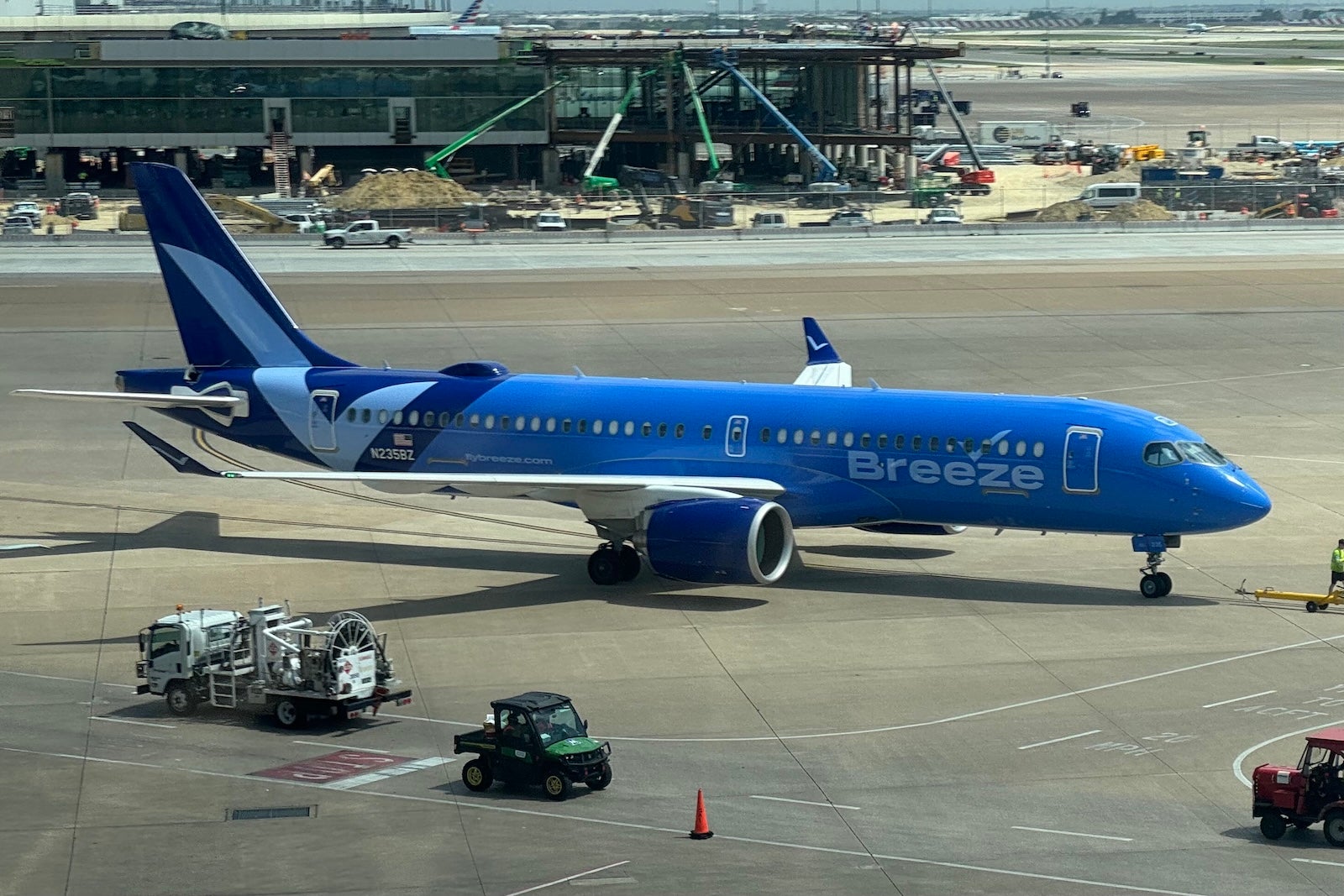
Breeze Airways is launching a 17-route expansion beginning July 1-3, including new service to Tallahassee (TLH) on July 2 and Birmingham (BHM) on July 3 with nonstop flights from each to Fort Lauderdale (FLL) and Raleigh-Durham (RDU), plus multiple new links from FLL, CVG, CMH, MYR, TLH and others. The growth strategy targets underserved markets and fills routes vacated by Spirit's retrenchment and recent exits by Silver Airways and JetBlue, while creating direct competition on several corridors with Allegiant, JetBlue and Southwest; Breeze nonetheless remains a very small FLL operator (under 1% of scheduled seats), limiting near-term competitive impact on larger carriers.
Market structure: Breeze’s 17-route push mostly reallocates capacity into underserved Sun Belt and intra-Florida links, benefiting leisure demand capture and local airports (TLH, BHM, FLL). Incumbents with heavy FLL exposure (JBLU) see both opportunity and marginal share bleed: Breeze flies <1% of FLL seats but replaces routes vacated by Spirit/Silver, implying local yield pressure of ~3–7% on affected thin routes vs. system yields. Suppliers (aircraft lessors) and regional airport revenues are small winners; Spirit’s shrinkage is a structural tailwind for incumbents but raises short-term seat oversupply risk.
Risk assessment: Tail risks include a prolonged Spirit asset dump creating national capacity >2% incremental seats and triggering a fare war, a DOT/DOJ antitrust action if incumbents coordinate, or a macro leisure demand slump (GDP decline >1.5% y/y) that crushes RASM. Time horizons: immediate (days–weeks) sees equity volatility around route start headlines and Spirit news; short-term (1–3 months) affects yields on those routes; long-term (3–12 months) depends on whether incumbents match low fares or retrench. Hidden dependencies: airport slot rules, codeshares and frequent-flier feed (JetBlue’s loyalty economics) will determine durable share gains.
Trade implications: Tilt toward long JBLU exposure sized modestly (1–3% NAV) to capture reallocation at FLL if JetBlue converts Spirit share — but cap position size because Breeze’s moves introduce local yield risk. Pair trades: long JBLU / short LUV (beta-adjusted) to express FLL share capture vs. broader domestic short-haul pressure; target 3–6 month horizon. Options: use limited-risk call spreads on JBLU (3–6 month buy 10% OTM / sell 25% OTM) sized to risk ≤0.5% NAV to play upside around July route launches and quarterlies. Rotate from cyclicals into travel/leisure names if weekly DOT pax + Cirium seat data show >2% month-over-month improvement.
Contrarian angles: Consensus may overstate Breeze’s threat — sub-1% seat share at FLL is unlikely to structurally dethrone JetBlue; market may underprice JetBlue’s loyalty/feed advantages that sustain higher RASM. Conversely, the market may underappreciate the cumulative effect of multiple small ULCC entries causing localized yield erosion of 5–10% that can pressure peers’ near-term guidance. Watch for unintended consequences: incumbents cutting fares to defend routes can compress sector margins for 2–4 quarters, creating a tactical window to sell into strength.
AI-powered research, real-time alerts, and portfolio analytics for institutional investors.
Request DemoOverall Sentiment
mildly positive
Sentiment Score
0.27
Ticker Sentiment
