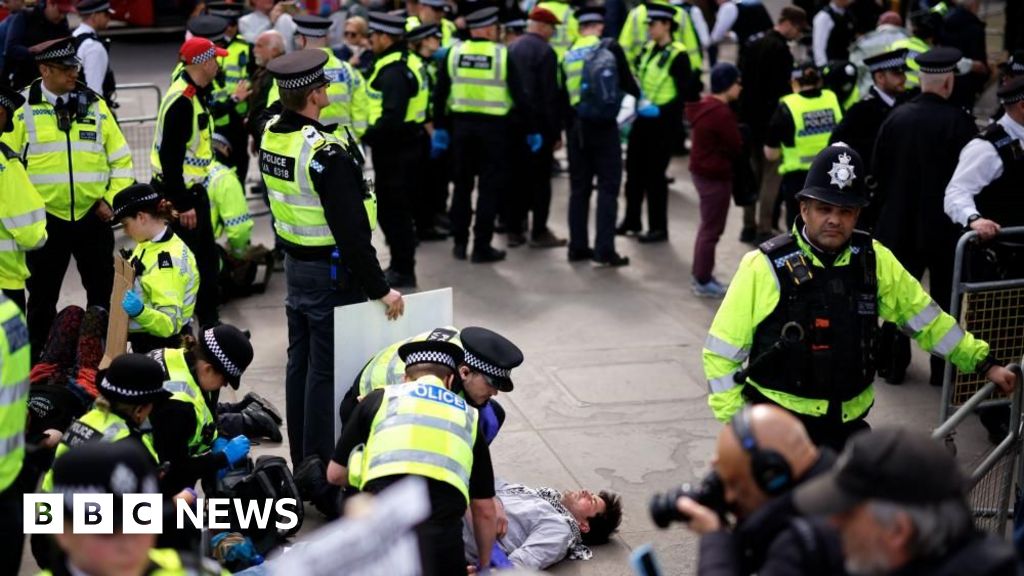
More than 500 people were arrested in central London during a protest against the ban on Palestine Action, bringing the total arrested since the group was proscribed to more than 2,200. The article centers on enforcement of anti-terror legislation, the ongoing legal challenge to the ban, and the broader political dispute over protest rights and the Gaza conflict. Market impact is limited and largely indirect.
This is less a direct market event than a governance stress test: a visible disconnect between legal authority, policing posture, and protester willingness to absorb arrest risk. The second-order effect is an increased probability of a rolling civil-liberties flashpoint that keeps pressure on UK domestic politics, especially if enforcement is seen as inconsistent across similar demonstrations. That matters for sentiment-sensitive UK assets because it raises the odds of higher security costs, more disorderly event-risk headlines, and a broader risk premium around public order.
The near-term catalyst is procedural rather than ideological: any appellate or judicial movement that changes the status of the proscription would immediately remove the arrest overhang, while a firm government re-endorsement would likely extend the confrontation. In the interim, the market should expect a pattern of repeated, low-level escalation rather than one-off shock, with each weekend event incrementally increasing the chance of injuries, legal challenges, or broader copycat activism. The key tail risk is a miscalculation that produces mass arrests on a politically charged day, triggering a larger domestic policing debate and forcing ministers to spend attention capital away from economic policy.
I would treat this as a modest negative for UK domestic risk assets, but the move is likely overdone if the market is pricing a lasting deterioration in broader public order. The contrarian read is that the state may ultimately regain control through selective enforcement and court process, making the current spike in headlines more of a volatility event than a structural regime shift. The better trade is to express the issue through event-vol rather than outright macro direction, since the direct economic transmission is weak unless the protest cycle widens materially.
For second-order winners, legal aid, public-order technology, and private security vendors should see incremental demand if police budgets and municipal event management costs rise. The real loser is political capital: every renewed arrest cycle raises the probability of policymaker defensiveness and crowded legislative bandwidth, which can delay other domestic reforms and keep UK headline risk elevated into the next quarter.
AI-powered research, real-time alerts, and portfolio analytics for institutional investors.
Request DemoOverall Sentiment
neutral
Sentiment Score
-0.10
