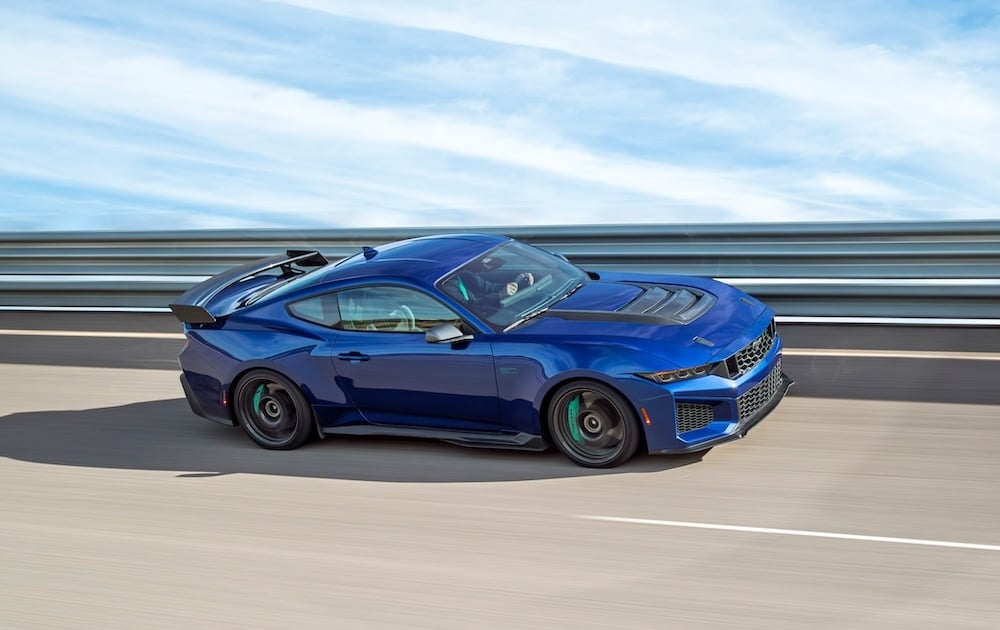
Ford Racing announced the Mustang Dark Horse SC will be entered into NASCAR competition at the Daytona 500 in 2027, unveiling the plan alongside the production model driven by Ryan Blaney. The track-focused Dark Horse SC—tested at Sebring and Virginia International Raceway—features a supercharged V8, Brembo carbon-ceramic brakes, Michelin Pilot Sport Cup2 R tires and aerodynamic updates; Ford will complete NASCAR's body submission, renderings and wind-tunnel approval process prior to the debut.
Market structure: Ford (F) receives a modest but real halo from inserting the Mustang Dark Horse SC into NASCAR in 2027 — expect brand-strengthening demand for high-margin performance options, not material volume uplift (estimate +0–2% unit growth for Mustang line 2027–2028). Direct beneficiaries include niche suppliers (Brembo BREM.MI, Michelin ML.PA) for carbon-ceramic brakes/tires; incumbents (Toyota, GM) face marketing pressure, not immediate pricing displacement. Cross-asset effects are marginal: limited impact on IG credit spreads or USD; slight support for specialty materials/commodity prices (carbon fiber, high-grade aluminum) over 12–36 months if production scales.
Risk assessment: Key tail risks are NASCAR body rejection, a high-profile racing incident causing reputational/recall costs, or cost overruns in homologation that compress margins (single-event downside >$0.02 EPS for F but larger for suppliers with concentrated revenue). Time horizons: days—negligible; weeks–months—media/marketing lift and supplier order visibility; long-term (2027 rollout)—realization of sales/merchandising and spare-parts revenue. Hidden dependencies include supplier capacity constraints (Brembo/Michelin) and Ford’s allocation trade-off vs EV capex; catalysts include NASCAR approval milestones (submit/approve body by <12–18 months) and OEM production announcements.
Trade implications: Tactical: establish a small 1–2% overweight in F (ticker F) funded from cash or underweight cyclical parts names, targeting +10–15% upside into 2027 with stop-loss at -8% within 12–18 months. Options: buy Jan 2028 LEAP call spread F (buy 15–20% OTM, sell 35–40% OTM) sized to 0.5–1% notional to capture 2027 publicity with defined risk. Pair trade: long BREM.MI (or ML.PA) vs short a broad auto-parts ETF/APTIV (APTV) to capture supplier re-rating if Brembo/Michelin secure supply contracts; size 1–2% net exposure.
Contrarian angles: The market underestimates intangible brand value — if Ford converts racing exposure into factory-backed accessories/limited editions, ASP uplift could exceed consensus by 1–2 pts in the Mustang cohort. Conversely, reaction could be overdone if investors price this as a volume driver; historical parallels (limited sales uplift from past motorsport halo launches) warn against large longs. Watch for unintended consequences: higher R&D/capex that may slow EV timelines; trigger to exit or hedge if Ford publicizes >$500M program spend or delays EV milestones by >6 months.
AI-powered research, real-time alerts, and portfolio analytics for institutional investors.
Request DemoOverall Sentiment
mildly positive
Sentiment Score
0.30
Ticker Sentiment
