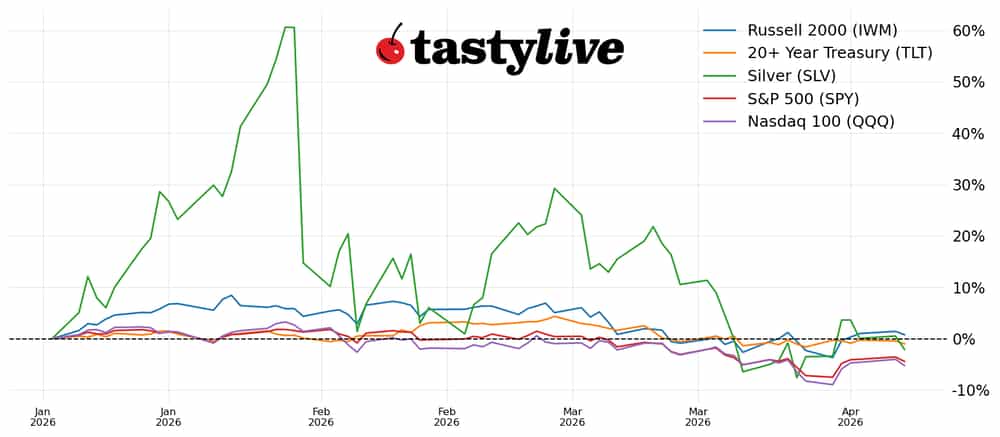
S&P 500 E‑Mini futures are down 3.43% year-to-date, with March selling driving prices from $6,700/$6,610 targets to a YTD low of $6,353.25; price has since bounced to ~ $6,665. Key near-term technicals: suport/resistance at $6,500 (retested Apr 2), downside target $6,360 if $6,500 breaks, and upside target $6,800 if buyers regain control. The piece also highlights earnings trade tactics for options—entering around earnings or using the monthly contract after earnings and rolling out to extend duration and collect premium to manage volatility.
The price action we've seen is primarily a flow-driven event: concentrated futures/ETF selling and dealer delta-hedging created a negative feedback loop that amplified moves vs fundamentals. That mechanism disproportionately penalizes levered, momentum and small-cap exposures because they are the quickest to be forced into liquidation; conversely, large-cap, high-liquidity stocks and defensives are structurally advantaged during such squeezes due to shallower transaction costs and index-rebalancing flows.
Options market structure is the lever to watch: elevated skew and concentrated open interest around recent trading bands mean dealers are short convexity and will hedge dynamically, which increases realized volatility on retests of those bands and magnifies short-covering rallies. Over the next 2–8 weeks, catalysts that change dealer hedging (not fundamentals) — large expiries, earnings season flows, or a volatility regime shift — will likely drive the largest intraday moves.
Risk profile: on a days-to-weeks horizon the biggest tail is a liquidity shock (fund redemptions, margin calls) that forces further outsized selling; on a months horizon the key reversal would be a breadth-driven regime shift (upgrade cycle, better-than-feared macro prints) that produces rapid short-covering. Monitor credit spreads and prime brokerage delta; widening credit or spikes in secured funding costs are quicker triggers for forced deleveraging than macro surprises.
Contrarian angle: consensus positions for continued grind lower underweight convex protection; that underprices the asymmetric payoff of buying short-dated convexity before large expiries and earnings windows. If dealers begin to buy gamma (IV drop + positioning unwind), a modest macro beat could produce >10% snapbacks in crowded long-short and small-cap segments within a week, making defined-risk long-vol and targeted pair reversals high expected-value plays.
AI-powered research, real-time alerts, and portfolio analytics for institutional investors.
Request DemoOverall Sentiment
mildly negative
Sentiment Score
-0.20
