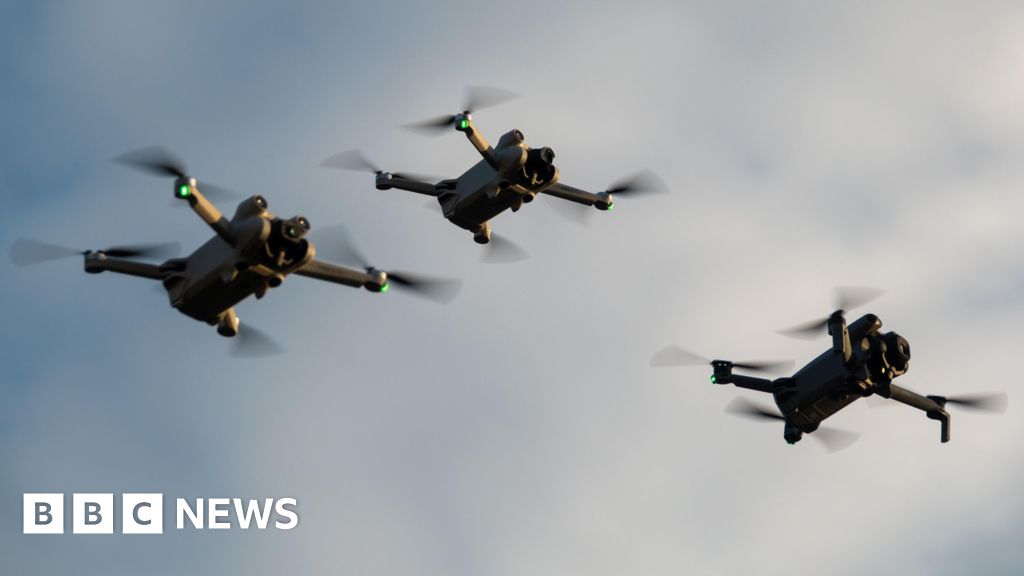
Drone incidents near UK military bases doubled to 266 in 2025 from 126 in 2024, prompting ministers to propose changes in the Armed Forces Bill to give the military powers to shoot down and take out threatening aerial and underwater drones. Officials warned some incursions 'can't rule out hostile state actors' amid wider European drone disruptions blamed on suspected Russian 'hybrid warfare'; the government is also investing in counter-drone technology while tightening domestic drone rules (flier IDs for drones ≥100g) and EU plans for a cross-border 'drone wall' are expected by 2027.
Market structure: The doubling of UK drone incidents (126→266 Y/Y) accelerates procurement demand for counter‑UAS and EW capabilities; clear winners are large defense primes and specialist C‑UAS vendors — e.g., BAE Systems (LSE:BA.L), QinetiQ (LSE:QNT.L), and US primes (RTX, LMT) — plus niche listed specialists such as DroneShield (ASX:DRO). Civil aviation operators (LHR.L, IAG.L) and insurers face higher operational and capex costs as airports install detection/jamming layers; expect suppliers to enjoy high‑single to low‑double digit incremental revenue growth in 12–36 months while unit costs for sophisticated RF/ai sensors stay elevated due to component constraints.
Risk assessment: Tail risks include state‑sponsored kinetic escalation causing shootdowns near civilian assets (weeks–months) and cascading insurance losses, or supply bottlenecks in RF semiconductors (3–12 months) that delay delivery. Immediate catalysts are the UK Armed Forces Bill (expected passage in coming months) and the EU “drone wall” program (operational 2027) — either can trigger multi‑year procurement waves; conversely, regulatory backlash or proof of false positives could slow adoption.
Trade implications: Favor 6–18 month directional exposure to defense primes and specialist C‑UAS: build 2–3% positions in BA.L and 1–2% in QNT.L; establish 2% US prime exposure via RTX (NYSE:RTX) or LMT (NYSE:LMT). Implement options: buy 3–6 month call spreads on RTX (e.g., 30% OTM buy spread) to cap cost while retaining upside into budget announcements; pair trade long BA.L vs short Heathrow (LHR.L) 0.5–1% to express differential capex winners/losers.
Contrarian angles: The market underestimates recurring revenue from software/monitoring and training (services > hardware) — companies with SaaS detection models are likely undervalued relative to hardware sellers. Past airport drone spates (2018–19) produced minimal long‑term defense upside until legislation; therefore price in procurement timing (6–24 months) and avoid paying up for unproven pure‑hardware names; beware kinetic escalation raising legal/insurance liabilities that could compress margins for vendors supplying weapons‑capable systems.
AI-powered research, real-time alerts, and portfolio analytics for institutional investors.
Request DemoOverall Sentiment
moderately negative
Sentiment Score
-0.30
