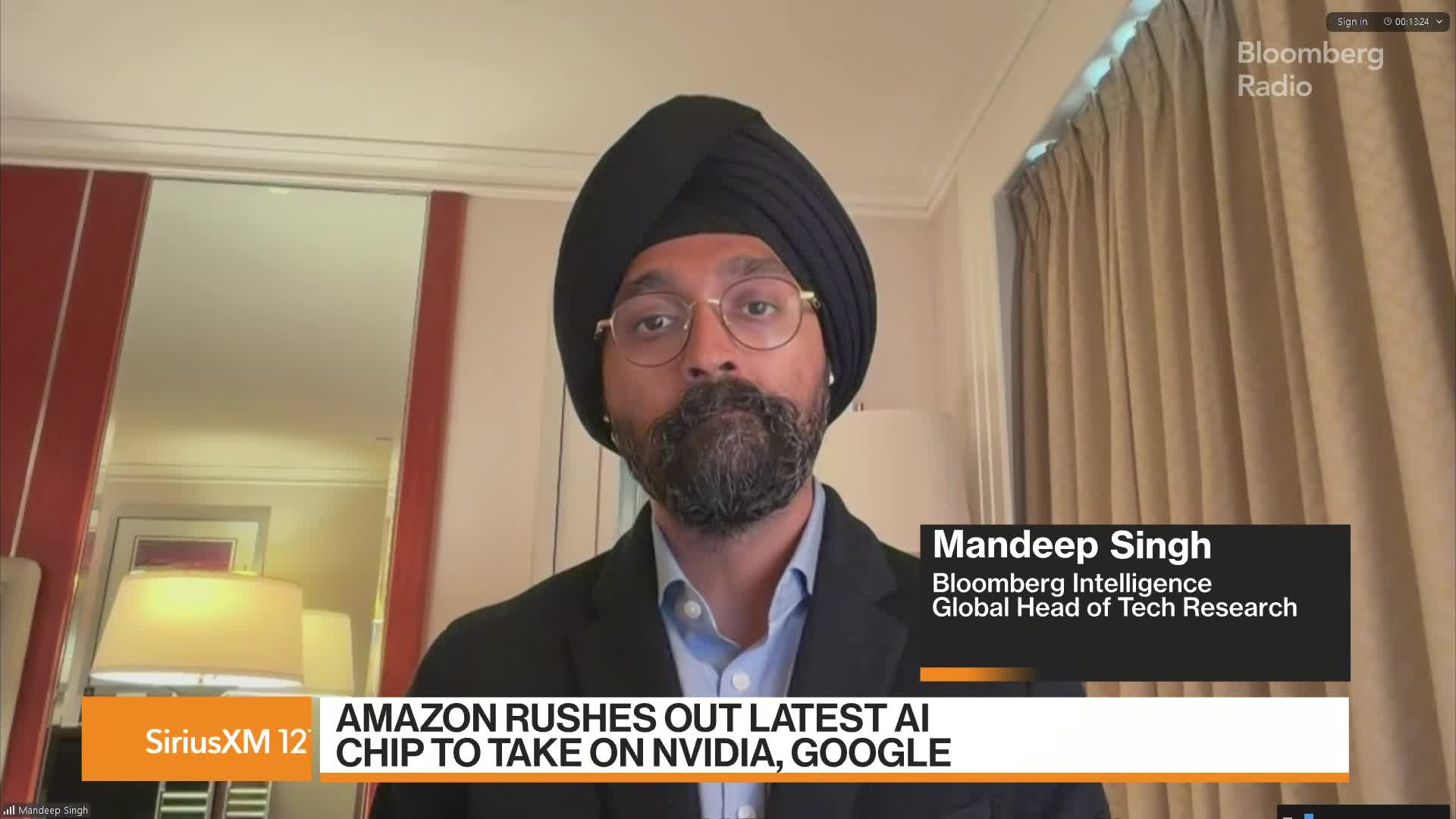
Hyperscalers are moving toward in‑house AI chips to reduce reliance on Nvidia, with Amazon attempting to replicate Google's lead in custom silicon even as Google remains ahead; the industry is expected to shift in 2026 toward CapEx efficiency as cloud providers seek to avoid spending an estimated 20–25% of CapEx on third‑party GPUs. Bloomberg analyst Mandeep Singh warns that Google’s large CapEx (cited at around $90bn) and integrated stack give it an advantage, while Apple is portrayed as lagging on an on‑device AI/model strategy and facing turnover that could pressure hardware sales over the next two years if it does not catch up.
Market structure: Hyperscalers (GOOGL, AMZN) are the primary beneficiaries as in‑house silicon reduces recurring spend on third‑party GPUs (article cites hyperscalers wanting to avoid 20–25% of CapEx on Nvidia). NVDA’s pricing power is at risk over 12–36 months if Google/Amazon push internal chips into training clusters; expect a scenario where 10–30% of hyperscaler GPU demand shifts by 2026, pressuring ASPs and OEM order cadence. Apple (AAPL) is a medium‑term loser if it fails to ship native OS models: quantify downside as a potential 3–7% CAGR haircut to device revenue from FY26 onwards if no strategy emerges.
Risks & timing: Tail risks include US export controls to China on accelerators and catastrophic delays in internal silicon (both 10–20% probability but high impact). Immediate (days–weeks): trade moves around NVDA earnings and hyperscaler guidance; short‑term (1–6 months): volatility spikes around re:Invent/GTC/Google Next; long term (12–36 months): structural demand shift to custom silicon. Hidden dependency: CUDA lock‑in and software stack migration costs slow chip substitution, likely elongating NVDA’s cash flow runway by ~12–24 months.
Trade implications: Express via relative value — long GOOGL LEAPs (12–24 months) and AMZN call spreads to capture cloud margin upside, while using NVDA downside protection (Jan‑2026 put spreads) rather than naked short due to near‑term momentum. Pair trade: long GOOGL vs short NVDA (equal dollar risk) to isolate hardware substitution thesis; size 1–3% portfolio each, initiate post next earnings if NVDA guides <consensus by >5%. Options: sell near‑term calls on NVDA to harvest IV, buy protective puts with 9–15 month expiries.
Contrarian view: Market may overestimate immediate NVDA disruption — CUDA/ecosystem inertia means revenue displacement is front‑loaded to 2026–2028, not 2024–25, so shorting NVDA today is timing‑sensitive. Conversely, AAPL risk may be underpriced; a lack of native models could erode hardware demand by FY27, making protective hedges on AAPL asymmetrically attractive. Historical parallel: Google TPUs reduced Intel/AMD server wallet share slowly while Google’s cloud margins improved; expect similar slow vendor displacement but eventual pricing pressure on NVDA.
AI-powered research, real-time alerts, and portfolio analytics for institutional investors.
Request DemoOverall Sentiment
mildly negative
Sentiment Score
-0.25
Ticker Sentiment
