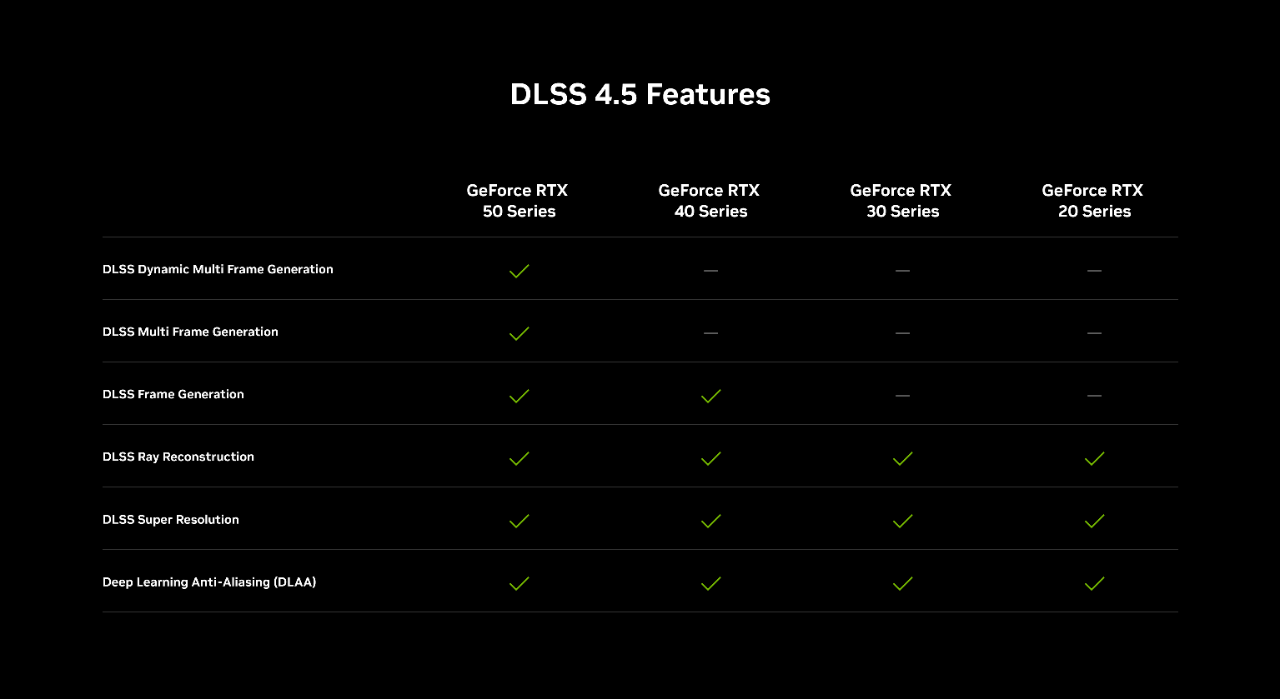
NVIDIA released a beta update to its NVIDIA app adding DLSS 4.5 Dynamic Multi Frame Generation with up to 6X Multi Frame Generation on GeForce RTX 50 Series (claiming up to +35% 4K frame rates in path-traced titles vs 4X). The update also introduces a new DLSS Frame Generation model that improves in-game UI clarity, DLSS 4.5 Super Resolution model presets (M/L/K), and a beta Auto Shader Compilation feature; all features require GeForce Game Ready Driver 595.97 WHQL and opt-in to app beta/experimental settings. Several major titles (e.g., Battlefield 6, God of War Ragnarök, Marvel’s Spider-Man 2, Starfield, The Outer Worlds 2) are listed as supported as of March 31, 2026.
NVIDIA’s continued software-led improvement to perceived GPU performance deepens a non-hardware moat that’s hard for competitors to match quickly: once developers bake in NVIDIA-specific optimizations and players grow accustomed to higher effective frame rates on high-refresh panels, switching costs rise materially. Expect a multi-quarter cadence where software-driven user experience becomes an increasingly important buying criterion for premium gamers and OEMs, allowing NVIDIA to extract higher ASPs on new flagship cards or sustain pricing even if unit growth moderates.
A less obvious chain: pushing higher perceived refresh utilization increases demand for complementary hardware — high-refresh OLED/IPS monitors, faster display interfaces, and beefier VRR ecosystems — which benefits panel makers and accessory suppliers and creates a secondary aftermarket uplift. Conversely, it raises sensitivity to supply constraints in very specific bill-of-materials (memory, display IO silicon, board-level power delivery), meaning a small manufacturing hiccup could translate into outsized pricing power for NVIDIA-enabled boards.
Key near-term risks are governance and durability: driver-level features that alter game rendering invite both developer pushback and post-deployment quality issues that can surface in weeks, not quarters, creating sharp sentiment swings. Over 3–12 months, the primary catalysts to watch are adoption rates in top-50 PC titles, any public developer endorsements (or rejections), and measurable changes in ASPs/unit shipments in NVIDIA’s peripherals/consumer segments; a rapid competitive feature parity from rivals would materially compress the upside.
From a portfolio-construction standpoint, this is asymmetric: software-driven expansion increases the probability of upside to consensus estimates without a proportional near-term spend increase, but it concentrates regulatory and reputational risk. Position sizing should therefore favor convexity (long options) and managed exposure to outright equity, with readiness to trim on supply-cycle or compatibility headlines that can reverse sentiment within days.
AI-powered research, real-time alerts, and portfolio analytics for institutional investors.
Request DemoOverall Sentiment
mildly positive
Sentiment Score
0.25
Ticker Sentiment
