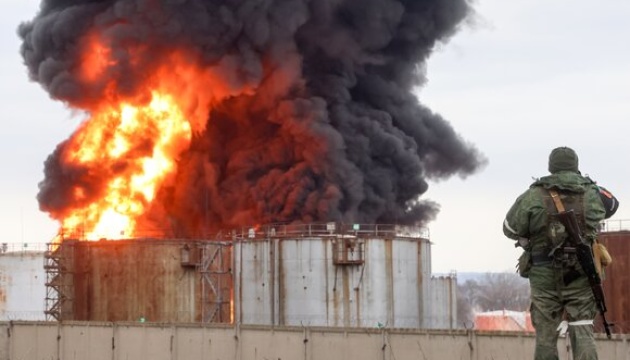
Russian authorities confirmed a reported Ukrainian drone strike on an oil depot in Stary Oskol (Belgorod region), with detonations and multiple storage tanks alight and firefighting crews responding; the claim was supported by regional governor statements and photos/videos published on Telegram. Russia's Ministry of Defense said it shot down 23 drones (11 over Belgorod) on Jan. 6 and Ukraine's General Staff reported additional strikes on military and energy-related sites, elevating operational risk to Russian energy infrastructure and posing potential upside pressure on regional fuel supplies and price volatility.
Market structure: Immediate winners are global liquid hydrocarbon suppliers and Western integrated oil majors (XOM, CVX, XLE) that can flex supply and book risk premia; security/insurance and energy services firms (SLB, HAL) also gain in bidding power. Direct losers are Russian regional fuel logistics, local refiners and insurers, and Russian-risk proxies (RSX, Moscow-listed energy names) as local storage and transport disruption raises costs and localized scarcity. Pricing dynamics: expect a near-term risk premium of $1–3/bbl Brent on headline strikes and +$5–10/bbl if strikes scale to major export infrastructure (>0.5–1.0 mbpd), shifting margins toward producers with spare export capacity.
Risk assessment: Tail risks include a coordinated campaign that knocks out 0.5–1.0 mbpd of Russian exports (high-impact, <10% probability) producing $15–30/bbl shocks; sanctions escalation or Black Sea port closures are second-order amplifiers. Time horizons: days—volatility and Brent spike; weeks–months—risk premium persistence if strikes recur; quarters—capex diversion and logistical cap constraints. Hidden dependencies: winter gas/heating demand, insurance premium repricing, and rerouting costs that can keep spreads wide even if physical outages are repaired.
Trade implications: Tactical long exposure to XOM/CVX or XLE (1–2% NAV) with 1–3 month horizon to capture risk premium, paired with small short RSX (0.5–1% NAV) to hedge geopolitically driven drawdowns. Options: buy 3-month Brent call spread (long 5% OTM, short 12% OTM) sized to 0.5% NAV, target 30–100% payoff if Brent moves +$5–10, stop-loss if Brent falls 5% from entry. Rotate into energy services (SLB) on pullbacks >8% as capex rerates; hedge portfolio FX risk with +USD / short RUB if available.
Contrarian angles: Consensus may overprice sustained supply loss—most depot strikes are tactical and repairable, so mean-reversion within 4–8 weeks is credible (2019 Aramco precedent). Market may underprice winners in energy infrastructure midstream outside Russia (ENB, EPD) which benefit from rerouting and higher tolls; conversely, oil-major reratings could be capped by recession risk—avoid leverage and size positions to 1–2% NAV with explicit stop/target rules.
AI-powered research, real-time alerts, and portfolio analytics for institutional investors.
Request DemoOverall Sentiment
moderately negative
Sentiment Score
-0.45
