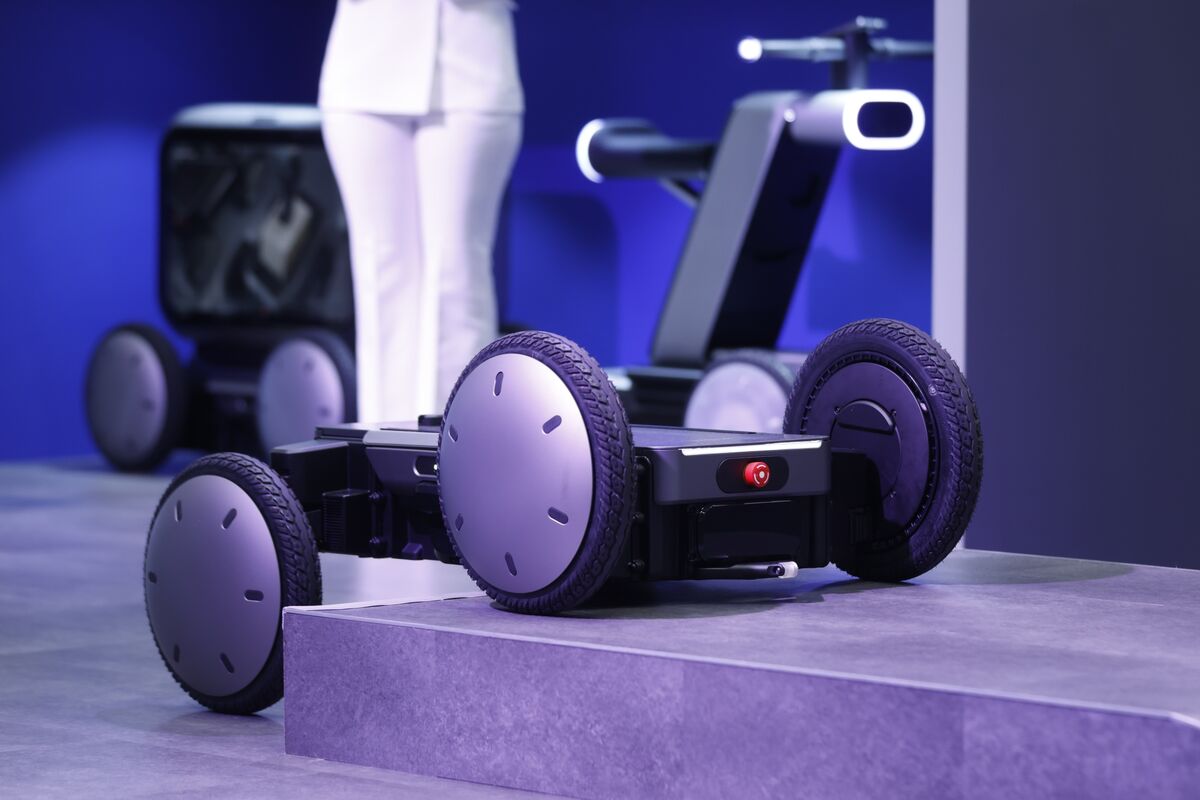
Hyundai Motor Group will begin production in the first half of next year and start selling the Mobile Eccentric Droid, its first mass-produced four-wheeled AI-powered mobility robot platform, next year. With autonomous navigation and integrated sensors, the platform is positioned for use cases ranging from deliveries to film-making, signaling Hyundai's strategic push into advanced mobility and robotics beyond its core automotive business.
Market structure: Hyundai’s mass-produced four-wheeled robot crystallizes a hardware-software supply chain trade: winners include Hyundai Motor (005380.KS / HYMTF ADR), Hyundai Mobis (012330.KS) and suppliers of compute/sensors (NVDA, LAZR) while incumbents in human-driven last-mile logistics face gradual displacement. Expect 12–24 month step-up in demand for LIDAR/vision chips (conservative estimate: +30–50% incremental unit demand vs. baseline) which supports semi pricing power; OEMs without integrated robotics stacks risk margin erosion and lost fleet contracts.
Risk assessment: Tail risks include regulatory safety bans, liability/recall costing hundreds of millions, and a renewed chip/sensor shortage; low-probability but high-impact scenarios could push commercialization out 12–36 months. Immediate market reaction (days) should be muted; watch H1 production start as a short-term catalyst (weeks–months) and fleet adoption metrics over 12–36 months for real earnings impact; hidden dependency: third-party software/maps and insurance capacity.
Trade implications: Position into H1 production newsflows — long select OEMs and upstream semis, short legacy logistics/low-tech OEMs; options can express convexity around product announcements (buy call spreads on NVDA or HYMTF). Rotate into Robotics/AI hardware and semiconductors, underweight traditional auto parts where robotics adoption will compress aftermarket services; set objective triggers (e.g., public orderbook >5k units) to add risk.
Contrarian angles: Consensus overestimates near-term consumer uptake and underestimates integration/insurance costs — early production could lead to negative headlines and selective de-rating. Historical parallel: early EV hype (2015–2018) where hardware promises outpaced regulation and infra; watch for demand gaps and price compression in sensors if suppliers overbuild capacity within 18 months.
AI-powered research, real-time alerts, and portfolio analytics for institutional investors.
Request DemoOverall Sentiment
mildly positive
Sentiment Score
0.28
