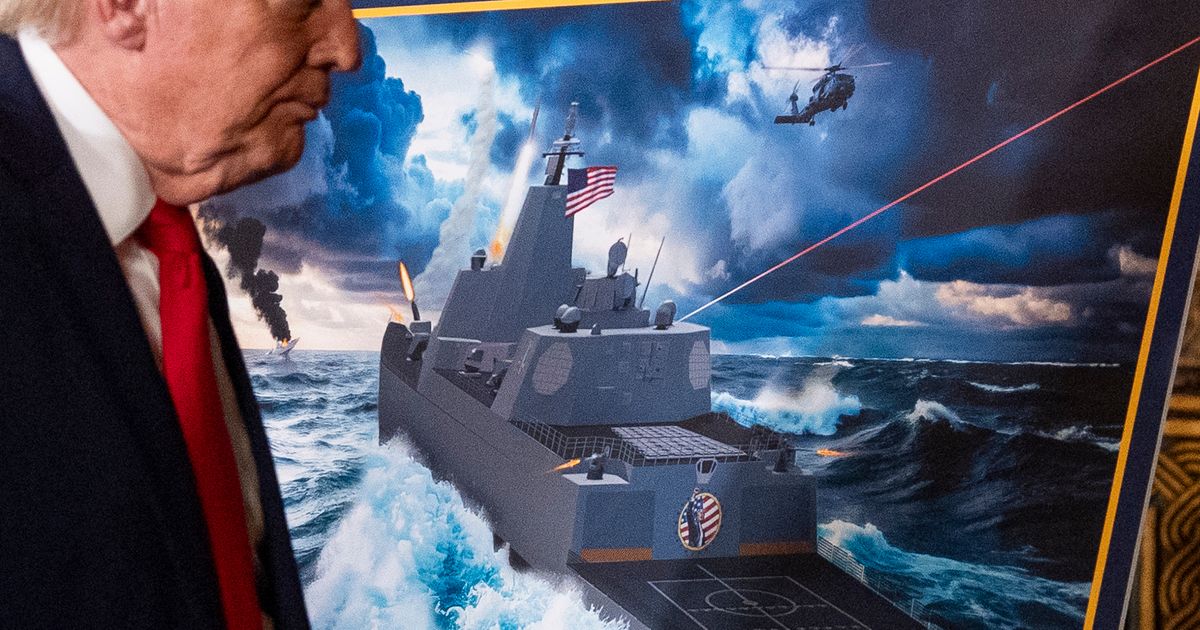
President Trump unveiled plans for a new class of large “guided missile battleship” called the USS Defiant as part of a proposed “Golden Fleet,” with design work under way and construction targeted for the early 2030s. The vessel is described as roughly 35,000 tons with crews of 650–850 and armed primarily with missiles — including claims of hypersonic and nuclear cruise missiles, railguns and high-powered lasers — even as the Navy has struggled with delays, cost overruns and abandoned technologies (notably the railgun) and potential treaty issues for deploying nuclear cruise missiles. The announcement comes amid recent Navy program cancellations and modernization challenges, signaling potential implications for defense procurement priorities, program budgets and shipbuilding contractors over the coming decade.
Market structure: A Trump-driven surface combatant program most directly benefits US shipyards (Huntington Ingalls HII), systems integrators (Lockheed LMT, Raytheon RTX, Northrop NOC) and high-grade steel/composites suppliers (Nucor NUE) because US yard capacity is constrained; estimate incremental margin leverage of 5–15% for yards if new orders exceed $5–10bn over 3–5 years. Losers are niche experimental tech plays (railgun IP) and treaty-exposed weapons (nuclear cruise missiles) where regulatory/legal risk will compress returns and delay revenue recognition.
Risk assessment: Major tail risks include treaty/legal blocks (could terminate nuclear cruise missiles), program cancellation for cost/time overruns, and political reversals; these are low-probability but high-impact and can materialize across FY2026–2032. Key catalysts: FY2026–FY2027 DoD appropriations (3–12 months), RFP/IDIQ awards (6–24 months), and any Navy design contract >$3bn; absence of awards by 12 months materially lowers thesis.
Trade implications: Tactical trades favor concentrated, time-limited exposure to HII (surface shipbuilder) and RTX/LMT (weapons & sensors) via LEAP call-spreads to limit downside; use a relative-value pair (long HII vs short GD) to isolate surface-ship beta. Rotate out of commercial/maritime cyclical names and reduce long-duration Treasury exposure modestly if Congress signals extra deficit-financing for defense (+$10bn+ could push 10y yields +5–25bps over baseline).
Contrarian angles: Markets may overprice futuristic tech content; the real monetization is in hull construction and systems integration, not vaporware hypersonic/railgun headlines. Historical parallel: 1980s battleship refurbishments produced limited durable demand — if new awards are symbolic rather than large, defense primes’ multiples already rich and upside will be muted.
AI-powered research, real-time alerts, and portfolio analytics for institutional investors.
Request DemoOverall Sentiment
mildly negative
Sentiment Score
-0.30
