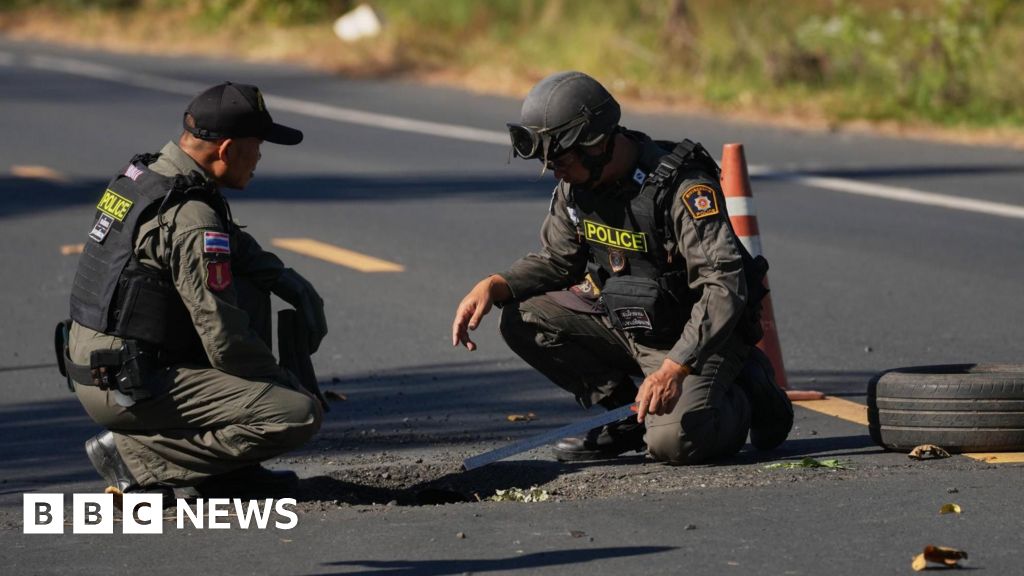
Thailand and Cambodia announced an immediate ceasefire that froze troop movements and allowed civilians to return after weeks of clashes that killed at least 41 people and displaced nearly a million; the truce took effect at noon local time and stipulates the release of 18 Cambodian soldiers held by Thailand once the ceasefire holds for 72 hours. The agreement reiterates commitments from the Kuala Lumpur Declaration and follows prior broken truces and recent Thai air strikes in the disputed border area. For investors, the deal reduces near-term tail-risk to regional assets and tourism-related sectors but remains fragile given recent breakdowns and political sensitivities, so exposure to Thailand/Cambodia risk should be managed cautiously.
Market structure: A sustained ceasefire materially reduces near-term tail risk for Thailand exposure — primary beneficiaries are Thai travel & domestic consumption (Airports of Thailand AOT.BK; MSci Thailand ETF THD), local banks (improved asset quality prospects) and the Thai baht (likely 1–3% appreciation if calm persists). Losers are localized Cambodian border economies and any insurers/SMEs with concentrated exposure to displaced populations; global defence primes see negligible revenue impact given scale of this skirmish.
Risk assessment: Key tail risks are renewed cross‑border strikes, escalation involving outside backers (China/US diplomatic friction) or a breakdown within 72 hours before the soldier release; probability low-medium but impact high on tourism and FX. Time buckets: immediate (72 hours) is binary; short-term (1–3 months) determines tourism season recovery; long-term (>6 months) depends on troop withdrawal and observer deployment. Watch triggers: 72‑hr hold, 30‑day troop withdrawal, THB moves >1.5% or sovereign yield widening >30bp.
Trade implications: Tactical allocation: overweight THD (2–3% portfolio) and selective names like AOT.BK (1–2%) with 3–6 month horizon, hedge with USD/THB forwards or 3‑month put on THD (stop-loss 7%). Pair idea: long THD, short EEM (0.5–1% net exposure) to express Thailand outperformance within EM. Options: buy THD 3‑month ATM calls or AOT 3‑month call spreads to cap premium, enter within 5 trading days if 72‑hour ceasefire holds.
Contrarian angles: Consensus may underprice persistent low‑level instability — peace could be fragile, so outright large longs are premature; conversely defence-equity tailwind expectations are overdone and shorting small regional defence suppliers or AD hoc contractors is viable if they rallied >15% on conflict headlines. Historical parallels (Thai unrest cycles) show tourism and FX typically recover 6–12 months; monitor implementation milestones rather than headlines to avoid whipsaw.
AI-powered research, real-time alerts, and portfolio analytics for institutional investors.
Request DemoOverall Sentiment
neutral
Sentiment Score
0.12
