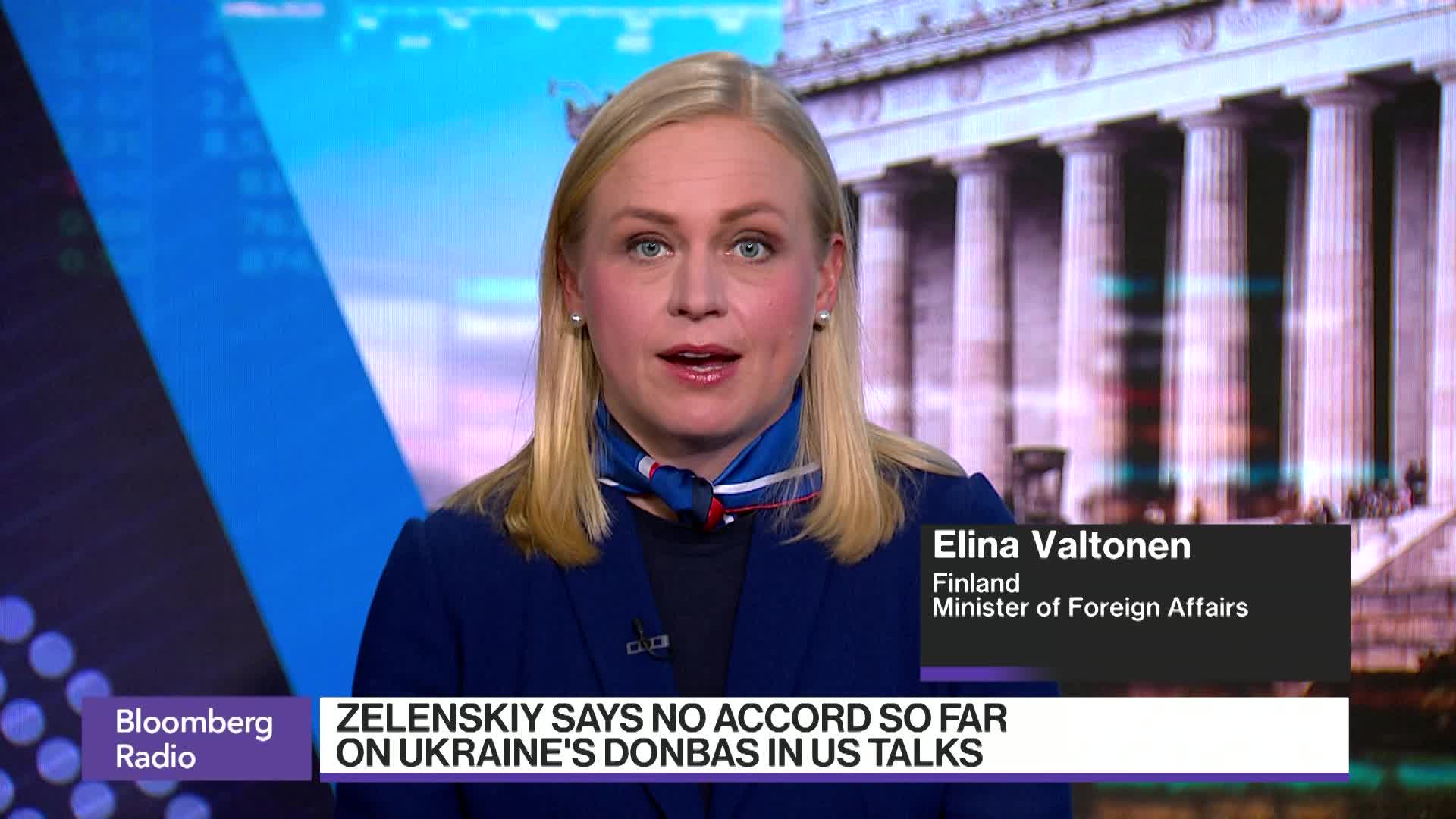
Finland's minister warns Russia remains the principal long-term threat to transatlantic security, stressing the need for continued deterrence and noting Finland and Sweden's NATO integration strengthens the alliance. He flagged concerns about a premature or costly peace for Ukraine and highlighted EU discussions to find a legally and politically sustainable mechanism to repurpose frozen Russian central bank assets to fund Ukraine's recovery, with EU heads of state meeting next week. The minister also called for deeper US‑EU trade ties while noting tariff frictions and emphasized coordinated sanctions and defense investment against Russian aggression.
Market structure: A sustained U.S.-Europe posture shift and talk of using frozen Russian central-bank assets solidify winners (defense contractors, energy exporters, agricultural suppliers) and hurt European financials, Russian-linked assets and trade-exposed European cyclicals. Expect a ~10–20% re-rating tailwind for large-cap defense names if NATO funding guidance accelerates in the next 6–12 months; oil and wheat spot prices are biased higher on continued export disruption risk. Cross-asset: USD and long-duration Treasuries are likely safe-haven beneficiaries in acute stress, while EUR and European credit spreads widen.
Risk assessment: Key tail risks include a rapid negotiated peace (defense downside risk, 3–6 month horizon), an escalatory Russian strike on NATO-adjacent territory (low-probability but >30% shock to energy and risk premia), and prolonged legal battles over asset seizures (raises sovereign reserve counterparty risk over years). Short-term (days–weeks) volatility spikes are most probable around NATO/EU summit decisions; long-term (quarters) is driven by defense budgets and reconstruction flows for Ukraine. Hidden dependency: European banks’ indirect exposure via frozen asset litigation and FX mismatches could produce contagion even without direct sanctions.
Trade implications: Tactical: favor aerospace & defense (ITA or LMT/RTX/NOC) and energy majors (XOM/CVX) while hedging European equity exposure (VGK/SX7E puts). Use 3–9 month option structures to express views — bought calls on defense ETFs and inexpensive puts on STOXX Banks (SX7E) or VGK — and size positions 1–3% of portfolio with clear triggers (e.g., Brent > $85, EUR/USD <1.08). Rotate out of European cyclicals and banks into U.S. defense/energy over the next 1–3 months.
Contrarian angles: The consensus assumes permanent risk-off; underappreciated is that a stable, negotiated peace could create a 6–12 month fiscal tailwind into European reconstruction and EU–US trade liberalization, benefiting industrial exporters and engineering OEMs. Conversely, using frozen reserves as precedent raises long-term sovereign trust costs, boosting demand for non-Russian reserve assets and hard commodities — a structural positive for commodities and a structural negative for any currency-heavy reserve managers. Markets may be underpricing legal/operational complexity, so asymmetric option hedges are preferred.
AI-powered research, real-time alerts, and portfolio analytics for institutional investors.
Request DemoOverall Sentiment
moderately negative
Sentiment Score
-0.35
