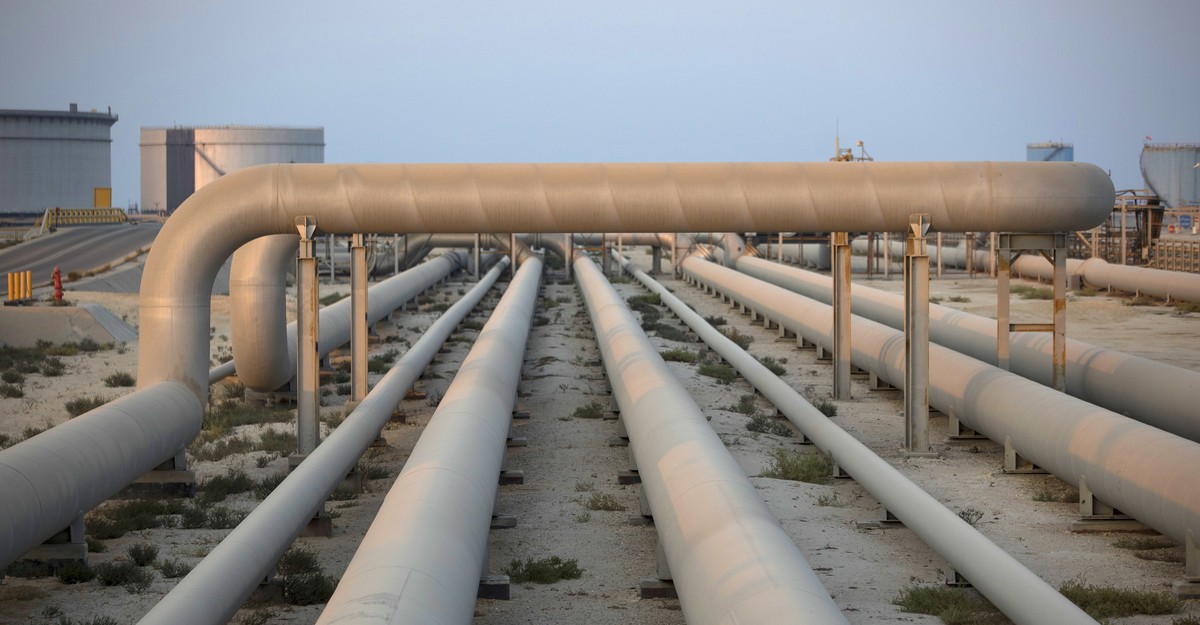
9–10 million barrels/day of crude have been removed from global markets by the near-closure of the Strait of Hormuz, alongside roughly 20% of global LNG supply and ~5 million barrels/day of refined products. Only two bypass pipelines exist (Saudi Petroline and the UAE ADCOP ~1.7 mbd) and are at or near capacity; the article urges doubling those capacities, building parallel refined-product lines, and constructing a new Iraq/Kuwait→Kurdistan→Ceyhan corridor. The author calls for coordinated international financing—anchored by U.S. diplomatic leadership and agencies like DFC and the World Bank—to avoid recurring, systemic energy shocks and to secure critical petrochemical and fertilizer supply chains.
The immediate market implication is a structural re‑rating of assets that own hard, immobile energy logistics — terminals, storage, export docks and the EPC contractors that deliver them. These assets convert geopolitical volatility into multi‑year contracted cashflows (take‑or‑pay, long-term throughput agreements), meaning equity re‑raters are likely to be firms with balance sheets able to underwrite cross‑border projects and capture tolling margins rather than spot commodity producers.
Time horizons diverge sharply: in days-to-weeks we should expect spikes in freight, storage contention and regional fuel rationing leading to dispersion in refining/refined-product crack spreads; in months-to-years a wave of capex decisions (pipeline duplications, product lines, export terminals) will redirect global trade lanes and lock in the parties that finance and build them. Catalysts that could unwind the trade are also clear — a de‑escalatory diplomatic package, coordinated SPR releases large enough to arbitrage forward curves, or rapid, China‑led financing of alternative corridors that shifts project economics.
Second‑order risks are broad: fertilizer and semiconductor feedstock tightness will transmit into agricultural input inflation and upstream cyclical capex delays; EM sovereigns with narrow FX reserves and import-dependent food systems are the highest convulsive risk for credit markets. Insurers and war‑risk underwriters will reprice region exposure, raising effective costs for shipping and long‑haul logistics — a stealth tax on global manufacturing margins.
For managers this is not a pure commodity call but an infrastructure allocation decision with optionality: favor owners of incremental throughput capacity and firms that can deploy global capital and political risk insurance; hedge with short‑duration tactical positions that monetize near‑term scarcity while keeping conviction long dated and conditional on project finance trajectories.
AI-powered research, real-time alerts, and portfolio analytics for institutional investors.
Request DemoOverall Sentiment
strongly negative
Sentiment Score
-0.60
