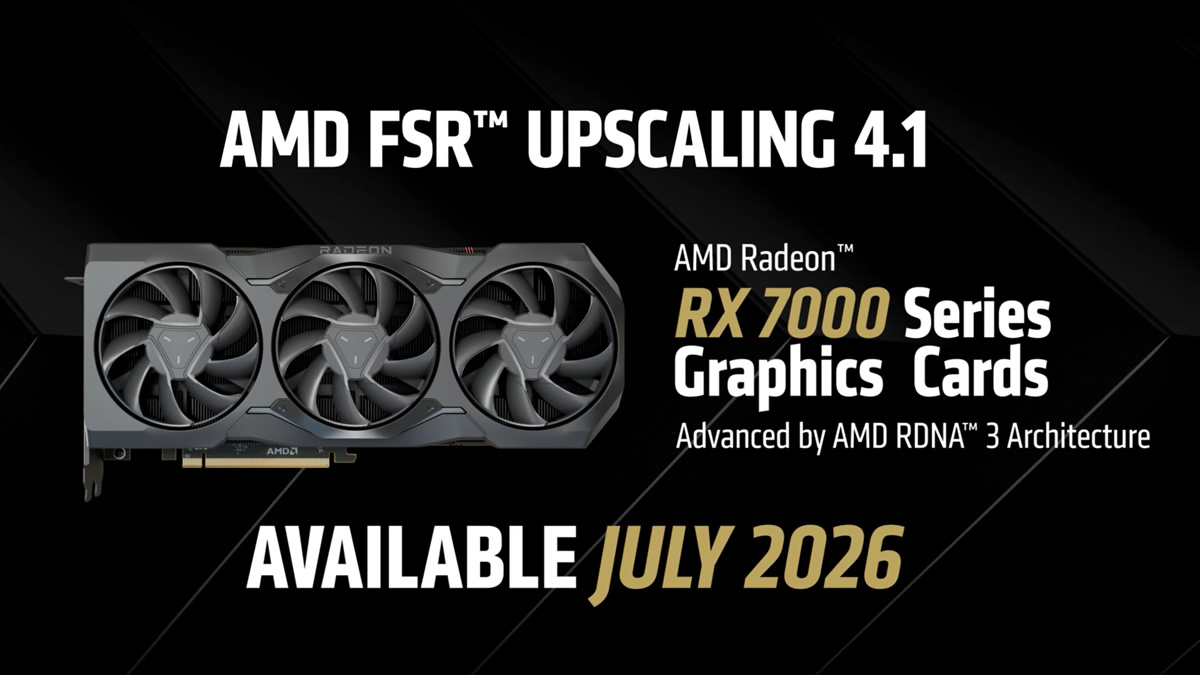
AMD confirmed FSR 4.1 support will expand beyond RDNA 4 to RDNA 3 GPUs in July and RDNA 2 GPUs in early 2027, ending exclusivity on newer Radeon hardware. RX 7000 users will get access across 300+ games at launch, while AMD says it reworked the algorithm to work without INT8 AI acceleration on RDNA 3. The update is broadly positive for AMD’s gaming ecosystem and could improve adoption across PCs, handhelds, and future console devices.
This is less about a feature update and more about AMD widening the installed-base moat for its software stack. By making the new upscaling layer usable on older cards, AMD increases the odds that developers target it as a default quality path rather than a marketing bullet tied to only the newest silicon. That shifts the value proposition from hardware-only differentiation toward ecosystem stickiness, which is incrementally positive for attach rates in GPUs, handhelds, and OEM gaming devices. The second-order winner is the console/handheld ecosystem, where better image reconstruction can extend the useful life of lower-power chips and reduce the need for brute-force raster performance. That matters because gaming devices are increasingly judged on perceived clarity per watt, not peak TFLOPs, and upscaling quality can be more important than raw frame rate in handheld form factors. If adoption is broad across 300+ titles, the incremental TAM is not just enthusiast PC users but OEM design wins and platform partners that can market "next-gen visuals" without a die-size penalty. Near term, the stock reaction may overstate direct revenue impact: this is not an immediate ASP lever, and monetization will mostly come through sentiment, mindshare, and potential share gains versus NVIDIA in the midrange and used-GPU market. The real catalyst window is the July rollout for RDNA 3, where execution quality and game compatibility will determine whether this becomes a durable narrative or a one-day headline. The main risk is that implementation complexity or mixed real-world image quality could cap adoption and keep developers anchored to competing solutions. The contrarian read is that the move is partially defensive: AMD may be responding to slower hardware upgrade cycles by making older cards feel newer, which signals a market where buyers are stretching replacement intervals. That can be bullish for share, but it also implies weaker unit growth if consumers decide software can postpone hardware refreshes. In that case, the best trade is not simply long AMD beta, but long AMD versus firms more exposed to pure hardware refresh demand.
AI-powered research, real-time alerts, and portfolio analytics for institutional investors.
Request DemoOverall Sentiment
moderately positive
Sentiment Score
0.72
Ticker Sentiment
