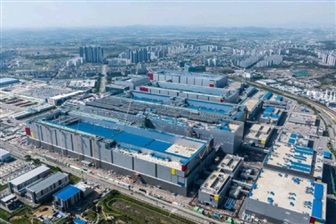
Samsung's foundry unit shows signs of gradual recovery with fab utilization forecasted to average in the low-60% range in H1 2026 (up ~10 percentage points from H2 2025), driven by increased wafer starts at 4nm and 8nm and a shift away from low-margin 8-inch products. Non-memory semiconductor losses narrowed from about KRW2 trillion in H1 2024 to around KRW1 trillion in H2 2024, while Samsung began mass production of the Exynos 2600 on 2nm in late 2025 with ~50% per-wafer yields and has a KRW22 trillion contract to make Tesla AI6 chips. Company-level guidance for Q4 2025 implies consolidated sales of ~KRW93 trillion and operating profit of ~KRW20 trillion (midpoints), but the foundry still needs >80% utilization to break even, underscoring the importance of stable advanced-node production to win large customers.
Market structure: Samsung's foundry recovery (utilization low-60% H1-2026 vs ~50% H2-2025) benefits Samsung (SSNLF / 005930.KS) and tier-1 materials/components suppliers tied to 4nm/8nm ramps, plus Tesla (TSLA) as a contract beneficiary (KRW22T). TSMC (TSM) retains pricing power at leading-edge nodes, so Samsung's share gains will be at mature/near-leading nodes rather than displacing TSMC immediately; break-even requires >80% utilization, so margin expansion is real but constrained. Cross-asset: improving Samsung fundamentals should support KRW and tighten its credit spreads, mildly bullish EM FX and Korean equities; limited direct commodity impact aside from specialty gases and silicon demand uptick.
Risks: Tail risks include 2nm yield failure (current ~50% per-wafer), Tesla contract delays/cancellations, or new US export restrictions affecting customer access—each could re-widen losses >KRW1T within quarters. Time horizons: immediate (days) — guidance already priced; short-term (3–9 months) — utilization/yield trajectory and wafer-start disclosures; long-term (12–36 months) — sustained >80% utilization and repeat design wins. Hidden dependencies: customer qualification timelines, capacity allocation between memory and foundry, and Samsung's willingness to discount to win share. Key catalysts: quarterly foundry utilization disclosures, Exynos yield improvements, and signs of TSMC capacity tightness.
Trade implications: Direct play — establish a modest 2–3% long position in SSNLF (or 005930.KS) targeting a 12-month hold, scalable on utilization >70% or Exynos yield >65%; pair trade — long SSNLF vs short TSM (ratio 1:0.75) sized to neutralize macro beta for 6–12 months. Options — use 6–9 month call spreads on SSNLF (buy ATM+15% / sell ATM+35%) to cap cost and capture a conditional rebound; consider a small 1% long TSLA position or LEAPS calls (12 months) to play downstream demand if Tesla AI6 ramps. Sector rotation — overweight Korean semiconductor equipment and advanced materials, underweight legacy 8-inch pure-play names until pricing improves.
Contrarian angles: Consensus underestimates Samsung’s realistic path to profitability by monetizing 4nm/8nm and the Tesla AI6 deal; however markets may be underpricing the time needed to reach 80% utilization, so near-term upside is capped. Historical parallels: prior Samsung foundry recoveries took 4–8 quarters after process stabilization, suggesting patience and milestone-based sizing. Unintended consequence: aggressive Samsung ramping could tighten mature-node supply and lift margins of legacy foundries, creating asymmetric winners beyond Samsung.
AI-powered research, real-time alerts, and portfolio analytics for institutional investors.
Request DemoOverall Sentiment
mildly positive
Sentiment Score
0.35
Ticker Sentiment
