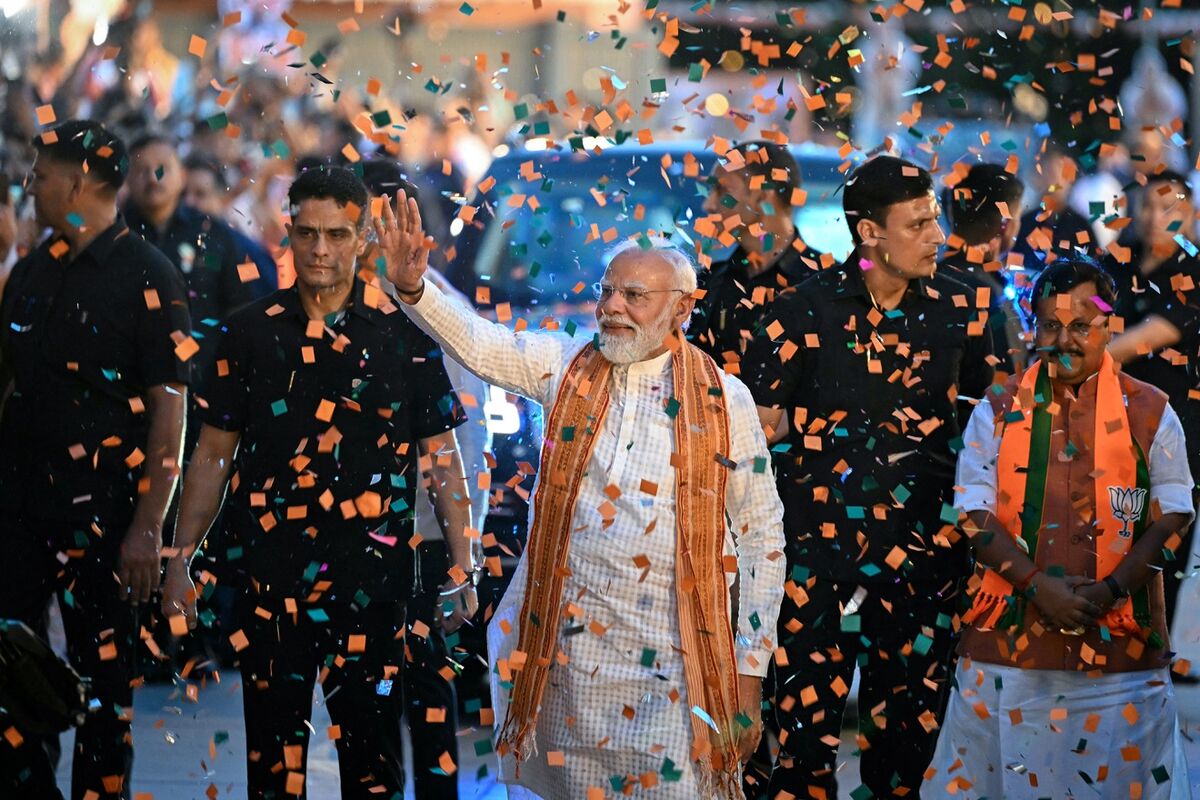
Narendra Modi strengthened his political position by expanding support beyond the BJP’s traditional north and west bases and sidelining two major opposition leaders in state elections. The outcome gives him fresh momentum to advance his political and economic agenda. The article is politically positive for the ruling party, though the direct market impact is likely limited.
The near-term market read-through is not a broad India beta bid so much as a governance-duration trade: a stronger governing mandate lowers the odds of policy paralysis, especially on capex execution, logistics buildout, and state-level reform spillovers. The first-order beneficiaries are domestic cyclicals tied to public investment and credit transmission, while the laggards are firms whose economics depend on fragmented regulation, subsidy leakage, or weak competitive barriers. In other words, this is less about one election result and more about a higher-probability path for administrative continuity over the next 6-18 months. Second-order, the biggest incremental winner is the coalition of companies that gain from faster land acquisition, permit approval, and centralized procurement: banks with infrastructure exposure, industrials, rail/highway suppliers, and defense-adjacent names. If the government uses the momentum to push privatization or tax/regulatory simplification, the re-rating can extend beyond the obvious domestic consumption basket into capital-intensive sectors with long project duration. Conversely, politically connected incumbents in regulated markets may face more competition if stronger mandate emboldens reform rather than patronage. The main risk is not an immediate reversal but policy overreach: a larger mandate can raise the probability of aggressive moves that unsettle parts of the market, especially around redistribution, religion-linked politics, or state-level backlash. Over a 3-12 month horizon, the key catalyst set is budget tone, capex allocation, and any steps on labor/land/tax reform; if those disappoint, the political premium fades quickly. The contrarian view is that this may already be priced as a general “India good” trade, so the better opportunity is relative value within India rather than chasing the index higher.
AI-powered research, real-time alerts, and portfolio analytics for institutional investors.
Request DemoOverall Sentiment
mildly positive
Sentiment Score
0.20
