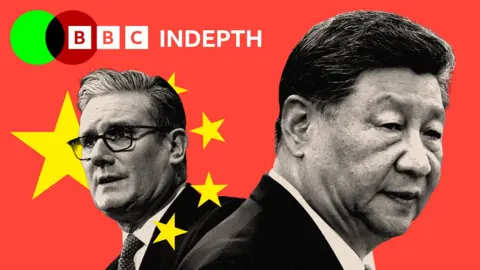
UK Prime Minister Keir Starmer has begun a three-day visit to China — the first by a UK leader in eight years — leading a delegation of roughly 60 British business leaders and scheduled to meet President Xi Jinping to pursue stronger trade and cultural ties. The trip aims to reset bilateral relations and explore commercial opportunities while assuring continued close security and economic ties with the US; it has drawn sharp domestic criticism over human-rights concerns, alleged Chinese espionage risks and controversy around a proposed large Chinese embassy in London. For investors, the visit signals potential reopening of high-level trade engagement with China but also highlights political and security risks that could limit near-term policy or investment commitments.
Market structure: A resumption of high-level UK–China engagement favors UK exporters of services and luxury goods, education and financial services (FTSE/UK small-caps) while keeping pressure on politically sensitive tech/telecom flows. Expect a modest GBP uptick (0.5–2%) and 25–75bp tighter credit spreads for UK corporates if a trade/dialogue narrative persists; Chinese outbound FDI to the UK may be volatile. Cross-asset: gilts could underperform (higher yields) on growth/FX support, while China equities/ADRs face idiosyncratic political risk premiums.
Risk assessment: Tail risks include a forced UK–US/China “choice” leading to tariffs, stricter FDI/tech bans, or espionage-driven sanctions (15–25% probability over 12 months) which would reprice China exposure and UK national-security-sensitive sectors. Immediate (days) risks are headlines; short-term (weeks–months) hinge on communiqué specifics; long-term (quarters+) depend on implementation and domestic political backlash. Hidden dependency: UK domestic politics can reverse any deal rapidly (elections, opposition-driven legislation).
Trade implications: Tactical relative-value trades favored—long UK-exposure vs short Chinese tech/consumer ADRs; buy GBP call spreads into 3-month windows; add small long positions in UK defense/cyber names as insurance. Use size discipline (1–3% portfolio per leg), set explicit triggers (e.g., take profits on GBP at +5–7%, stop-loss -3%).
Contrarian: Consensus underprices the political backlash risk and overprices a smooth trade revival; the market may be underweight UK midcaps that benefit from services deals. Historical parallel: détente-lite episodes often produce short-term asset rallies followed by stalling implementation—expect mean reversion by 3–9 months if deliverables are vague. Unintended consequence: approval optics (mega-embassy) could accelerate MI5-led restrictions, creating second-order losses for real estate and infrastructure investors.
AI-powered research, real-time alerts, and portfolio analytics for institutional investors.
Request DemoOverall Sentiment
mixed
Sentiment Score
0.05
