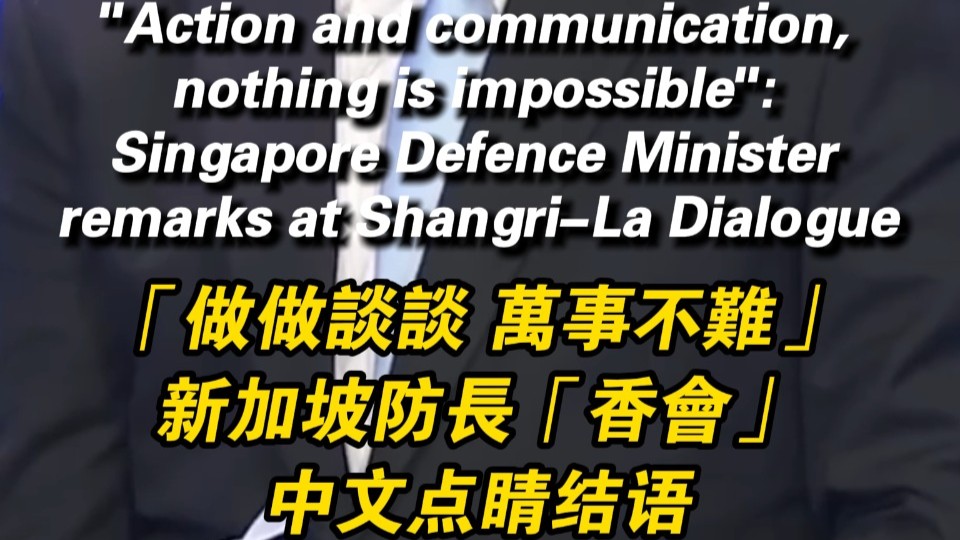
Singapore Defence Minister Chan Chun Sing urged ASEAN to combine action with communication and avoid framing the bloc as pro-U.S. or pro-China, emphasizing regional cohesion amid rising distrust and fragmentation. The remarks were broadly diplomatic and strategic in nature, with no direct market-moving policy announcement. Impact on markets is likely minimal.
The actionable signal is not the rhetoric itself but the policy architecture it implies: ASEAN is trying to de-risk from binary alignment and preserve optionality. That is constructive for regional capex because firms can keep funding cross-border infrastructure, defense procurement, and supply-chain rerouting without having to bet on a single security bloc; over 12-24 months this should support incremental spend in ports, logistics, cyber, surveillance, and dual-use industrials across Southeast Asia.
Second-order beneficiaries are not the loudest defense names, but the enablers: contractors tied to airport/port security, electronic systems, and local content integration. If ASEAN succeeds in presenting a neutral, stability-first posture, the region becomes a more attractive manufacturing hedge against China+1 fragmentation, which is positive for industrial real estate, power infrastructure, and selected semiconductor back-end supply chains. The main loser is the premium embedded in “policy surprise” risk — any vendor or commodity exposure priced on a severe escalation scenario may see implied volatility compress.
The contrarian risk is that “neutrality” can become a coordination slogan without execution, especially if member states keep diverging on maritime security and foreign investment screening. In that case, the market’s current preference for ASEAN diversification could reverse quickly, with capital expenditure delayed by 2-3 quarters and defense procurement skewing toward bilateral, not regional, contracts. The catalyst to watch is whether this rhetoric is followed by actual joint procurements, interoperability agreements, or infrastructure financing within the next two summit cycles; without that, the theme fades into noise.
For macro positioning, the trade is to own the region through quality domestic demand and infrastructure rather than outright geopolitical beta. The setup favors selective long exposure to beneficiaries of supply-chain diversification, while being cautious on any names dependent on a sharp rise in cross-strait or South China Sea tension. In a low-conflict base case, the alpha comes from reduced discount rates on long-duration regional growth assets, not from defense escalation.
AI-powered research, real-time alerts, and portfolio analytics for institutional investors.
Request TrialOverall Sentiment
neutral
Sentiment Score
0.05
