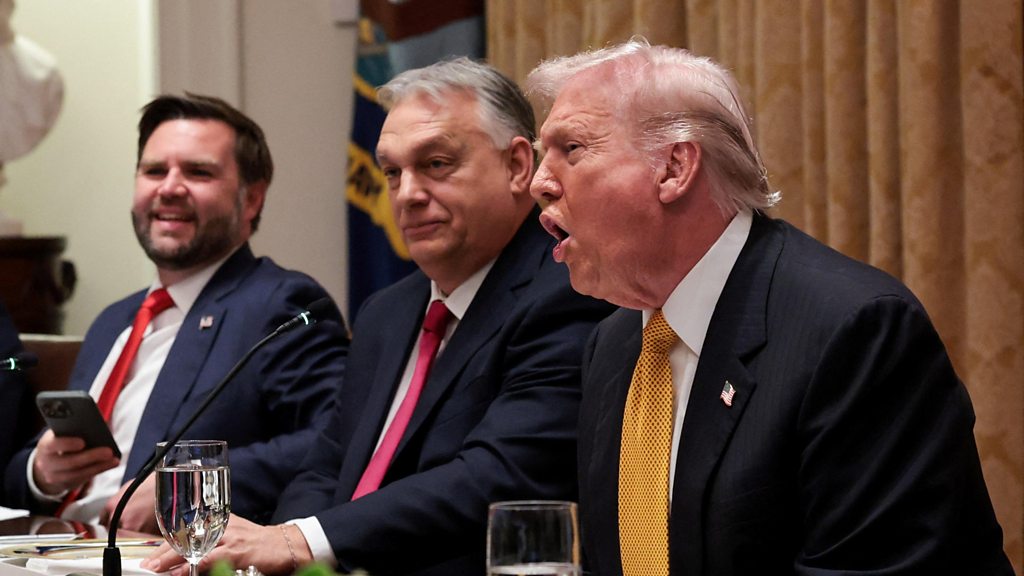
Hungary's parliamentary election next week could unseat Viktor Orbán after 16 years as prime minister, creating meaningful political uncertainty in the EU. The campaign has been highly volatile — allegations of Russian interference, staged assassination attempts and threats to release a sex tape — and is drawing heightened geopolitical scrutiny ahead of a planned US vice-presidential visit by JD Vance. For portfolios, elevated political risk could pressure Hungarian assets and raise regional volatility, but absent concrete policy changes the immediate market impact is likely limited.
Political convulsions in a small-but-strategic European market are a funded volatility event for CEE-exposed financials, energy contractors and defense procurement chains. Funding spreads for banks with large loan books in the region are the quickest transmission mechanism: a 50-150bp widening in senior wholesale funding costs can erase a full year of pre-provision profit for mid-sized Austrian/Central European banks, compressing equity multiples by 20-40% in 1-3 months if deposit confidence weakens.
Energy contract renegotiations and the unwinding of preferential bilateral gas deals would re-price margins for regional integrated oil & gas names and utilities. If market pricing normalizes toward EU hub prices over 3-12 months, integrated regional producers lose cash margin while European gas traders and storage owners capture backwardation-driven windfalls; a swing of €2-4/MWh in contract economics can move EBITDA by double digits for exposed players over a calendar year.
Geopolitical signaling—high-profile diplomatic visits, sanctions chatter or credible interference claims—are binary catalysts that compress risk premia in days but set multi-year policy trajectories. Over 6-18 months, outcomes that reduce alignment with broader EU/NATO policy will raise defense procurement tail risk; conversely, reintegration accelerates EU fiscal transfers and capex flows into infrastructure, rerating select industrials and banks. The most error-prone consensus is treating near-term headline volatility as the sole driver; the market should bifurcate trades by horizon and by whether exposure is funding- or contract-driven.
AI-powered research, real-time alerts, and portfolio analytics for institutional investors.
Request DemoOverall Sentiment
neutral
Sentiment Score
0.00
