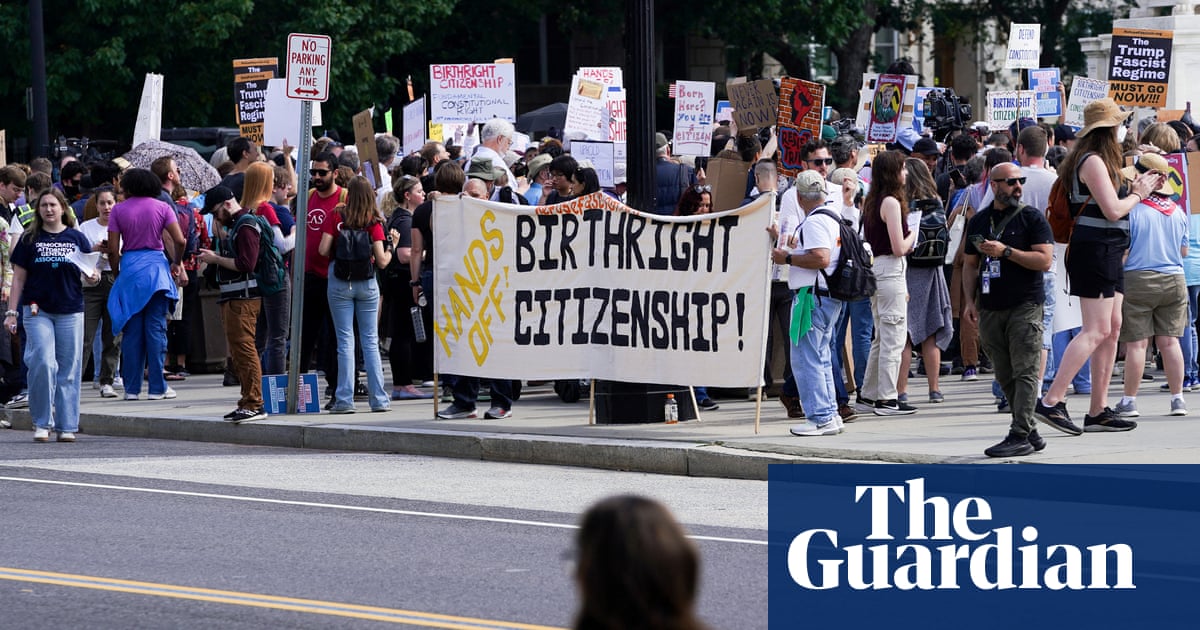
The US Supreme Court will hear arguments on whether President Trump's executive order can revoke birthright citizenship, a decision that would affect roughly 255,000 births per year and, per the Migration Policy Institute, could increase the unauthorized immigrant population by about 2.7 million by 2045 and 5.4 million by 2075. The order would apply to births after Feb 19, 2025 and seeks to reinterpret the 14th Amendment, overturning more than 125 years of precedent (United States v Wong Kim Ark). A class action (Trump v Barbara) led by the ACLU and state attorneys general argues the order is unconstitutional; a ruling for the administration would have major political and social consequences but is likely to produce limited direct market movement.
This dispute is best viewed as a structural shock to regulatory certainty rather than a one-off immigration policy change. If the Court narrows constitutional interpretation power to the Executive, expect a step-change in firms’ regulatory risk premia across sectors that rely on stable statutory baselines (healthcare, education, airlines, hospitality), raising compliance capex and borrowing costs for municipalities with large immigrant populations. The legal precedent pathway is binary but the market impact is graded: enforcement uncertainty pushes businesses to hedge via automation and tighter labor verification, while litigation and state-level countermeasures create a multi-year drag on certain local tax bases and services.
Second-order beneficiaries and losers are non-obvious. Vendors of detention and enforcement services, immigration-law boutiques, and compliance-software sellers would see secular demand lift under sustained enforcement; conversely, labor-intensive consumer sectors face margin compression and higher turnover costs. Political reaction — municipal policy workarounds, state-funded legal defense programs, and federal legislative fights — will amplify cashflow volatility for regional governments and increase short-term demand for legal and advocacy media, boosting subscription and engagement economics for outlets that monetize legal-political attention.
Timing and tail risks matter: the principal market catalyst is the Court’s ultimate ruling (decision window stretches across the current Term), but the bigger regime shift would arrive only if the decision is coupled with aggressive federal enforcement and slow congressional or judicial pushback. Reversal scenarios include rapid legislative clarification, procedural injunctions in lower courts, or active state-level immunity measures; each could compress the theoretical winners’ upside and produce sharp rebounds in sentiment for consumer-exposed names. Position sizing should reflect a high binary outcome with long-dated optionality rather than large outright directional exposure.
AI-powered research, real-time alerts, and portfolio analytics for institutional investors.
Request DemoOverall Sentiment
neutral
Sentiment Score
0.00
Ticker Sentiment
