A synthesis of past climate data, ice sheet observations, and numerical modeling indicates that the current global warming level of +1.2°C above pre-industrial levels, if sustained, could trigger rapid ice sheet retreat and accelerate sea-level rise beyond adaptation limits, challenging the Paris Agreement's +1.5°C target. The study suggests that a return to cooler-than-present conditions, potentially near +1.0°C above pre-industrial levels, is necessary to stabilize ice sheets, as current mass loss from Greenland and West Antarctica is already significant and potentially irreversible, posing an existential threat to coastal populations.
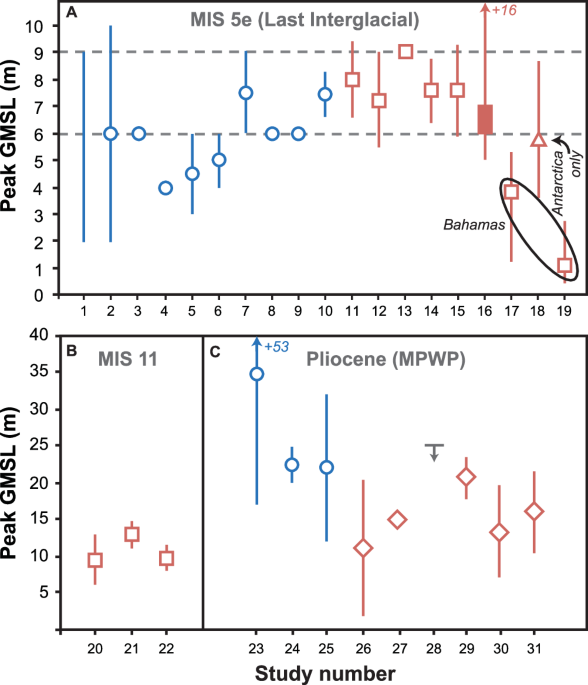
The scientific consensus presented indicates that the Paris Climate Agreement's target of limiting global warming to +1.5°C above pre-industrial levels is insufficient to prevent catastrophic sea-level rise (SLR), as current warming of +1.2°C, if sustained, is projected to generate several metres of SLR over the coming centuries. Mass loss from Greenland and Antarctic ice sheets has quadrupled since the 1990s, establishing them as the dominant source of global mean sea-level rise, which accelerated from approximately 1.4 mm year⁻¹ (1901–1990) to 4.5 mm year⁻¹ in 2023. Palaeo-records corroborate these concerns, showing that global mean temperatures +1.0 to +1.5°C higher than pre-industrial levels led to multi-metre SLR. Numerical models suggest that even the most optimistic IPCC scenarios (SSP1-1.9, stabilizing around +1.4°C) will not halt SLR from ice sheets, and current forcing could trigger instabilities leading to SLR rates exceeding 10 mm year⁻¹, challenging adaptation measures. The study highlights that conservative estimates project 20 cm of SLR by 2050 could result in US$1 trillion or more in annual global flood losses for major coastal cities. Furthermore, the research posits that a 'safe limit' for ice sheet stability likely lies at or below +1.0°C above pre-industrial levels, implying a necessary return to cooler-than-present conditions to avert irreversible tipping points, some of which may already be approaching for parts of the Greenland and West Antarctic ice sheets.
AI-powered research, real-time alerts, and portfolio analytics for institutional investors.
Request DemoOverall Sentiment
Negative
Sentiment Score
-0.70
