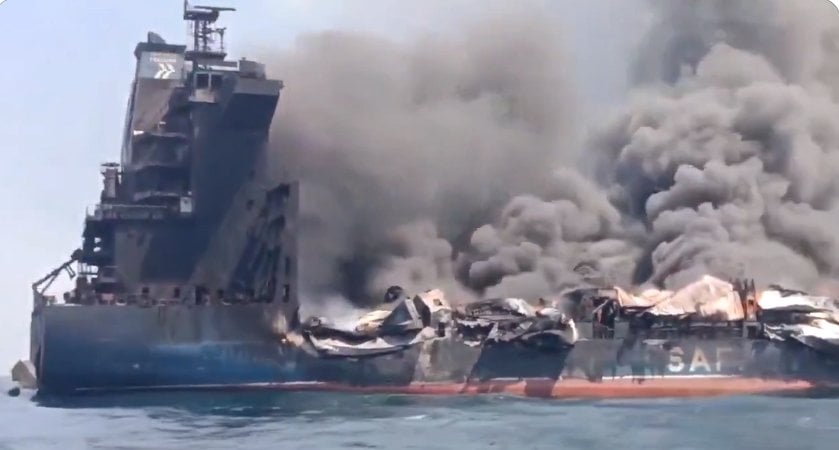
The containership Safeen Prestige is reported sunk after a fire following an Iranian attack; NAVEREA IX issued an alert on April 1 placing the wreck at ~120m depth roughly 6.5 nm NE of Ras Madrakah, Oman. The vessel (built 2013, 23,425 dwt, 1,740 TEU including 345 reefers) was first struck on March 4 and abandoned; a March 6 salvage tug was also hit, causing casualties. Expect elevated regional shipping risk, higher insurance/premium costs for Gulf transits and potential short-term upward pressure on energy and shipping rates due to route risk and debris/oil-slick hazards.
The immediate market impulse will be a persistent risk premium on Persian Gulf transits that crystallizes across three channels: elevated war-risk surcharges (WRS) on commercial invoices, higher hull & P&I insurance premia, and slower port rotations as operators inject slack to avoid choke points. Mechanically, that premium shows up as $-per-container pass-through within weeks on spot freight indices and as a rebooking tax on short-haul feeder loops, compressing operating leverage for low-margin feeder operators while boosting spot cashflows for global carriers with surplus lift.
Second-order supply-chain effects will amplify refrigeration and equipment mismatch risks: perishable shippers face outsized spoilage exposure as rerouting increases transit time by days and reduces available reefer slots, creating a near-term premium on refrigerated capacity and accelerating short-term demand for leased boxes. Ports and transshipment hubs that can absorb diverted flows (Persian Gulf alternatives, southern India, East African hubs) will see spike CAPEX and throughput pricing power over the coming quarters, tightening regional logistics supply and benefiting terminal operators with spare yard capacity.
Tail risks skew to escalation: a multi-week closure or sustained strike campaign would push crude and refined product freight further out via longer voyage distances, materially raising TCEs for tanker owners and potentially triggering political countermeasures (diplomatic corridor guarantees, naval escorts) that would cap the premium within 2–3 months. Conversely, a credible diplomatic de-escalation or coordinated insurance-market intervention (temporary WRS cap or government-backed war-risk facilities) could cause a rapid mean-reversion in freight and insurance spreads within weeks, leaving short-duration volatility trades as the highest-probability payoffs.
The structural takeaway: this shock magnifies the value of flexible asset owners and intermediaries (leased boxes, tanker and container spot fleets, terminal operators) and penalizes fixed short-haul feeder models and underinsured shippers. Position size and instrument choice should be calibrated to a binary geopolitical path — short-lived shock vs sustained rerouting — with option structures favored to asymmetrically capture upside while capping downside if diplomacy restores normalcy.
AI-powered research, real-time alerts, and portfolio analytics for institutional investors.
Request DemoOverall Sentiment
strongly negative
Sentiment Score
-0.70
