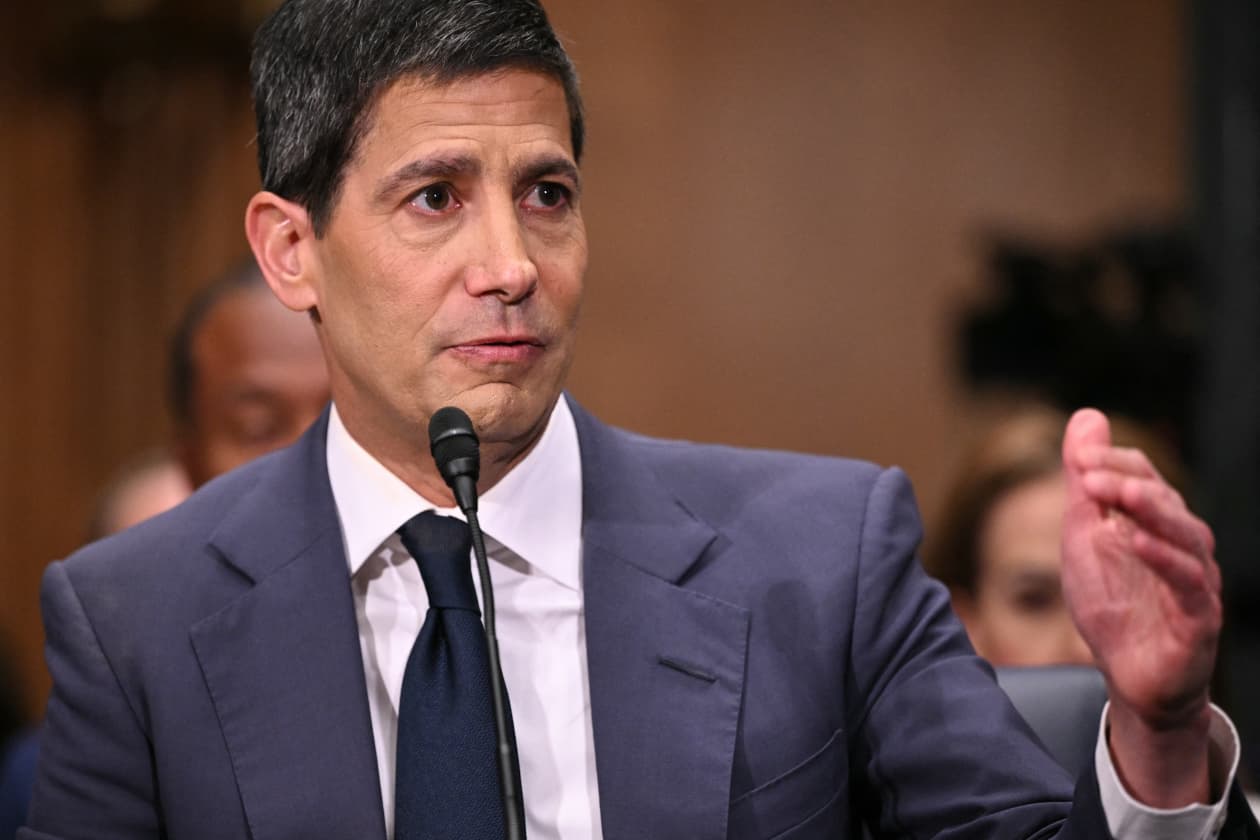
The Treasury market is already repricing higher, pushing interest rates up and tightening financial conditions before Kevin Warsh fully settles in as Fed chair. Yields across the roughly $30 trillion Treasury market are rising, which increases borrowing costs for the economy. The move is market-wide and could influence risk assets, rates-sensitive sectors, and funding conditions.
The market is effectively forcing a tighter policy regime before the new chair has even established credibility, which matters more for duration-sensitive assets than for the front-end rate path. The first-order winner is the Treasury carry trade unwind: as term premium rebuilds, leveraged duration holders, REITs, utilities, and long-growth equities face a mechanical de-rating even if the policy rate itself is unchanged. The second-order loser set is credit—especially lower-quality IG and HY borrowers that rely on window conditions for refinancing—because higher all-in funding costs can bite before default data does. The more interesting dynamic is that this can become self-reinforcing if mortgage rates and corporate spreads widen together. That tightens financial conditions without any formal Fed action, which raises recession probability in the 6-12 month window and creates a policy trap: the Fed can either validate market tightening or push back and risk a disorderly repricing. In that setup, banks are mixed—net interest margins may improve at first, but loan growth and credit quality typically deteriorate with a lag. Consensus may be underestimating how quickly this repricing can reverse if growth data softens. A hawkish chair plus rising yields is only durable while labor and inflation remain sticky; a single weak CPI or payroll sequence could trigger a sharp bull-steepening rally as the market re-prices terminal policy lower. So the right framing is not directional rates exposure, but convexity: the move higher in yields can persist for weeks, while the downside reversal risk is sudden and nonlinear. From a technicals standpoint, this is a bad backdrop for crowded long-duration positioning and any strategy that implicitly sells vol through stable-rate assumptions. The cleaner expression is to own protection where financing sensitivity is highest and to avoid chasing outright short-duration after the first leg of the move. If the market is doing the Fed’s job for it, the trade is to fade leverage, not to predict the next FOMC headline.
AI-powered research, real-time alerts, and portfolio analytics for institutional investors.
Request DemoOverall Sentiment
mildly negative
Sentiment Score
-0.25
