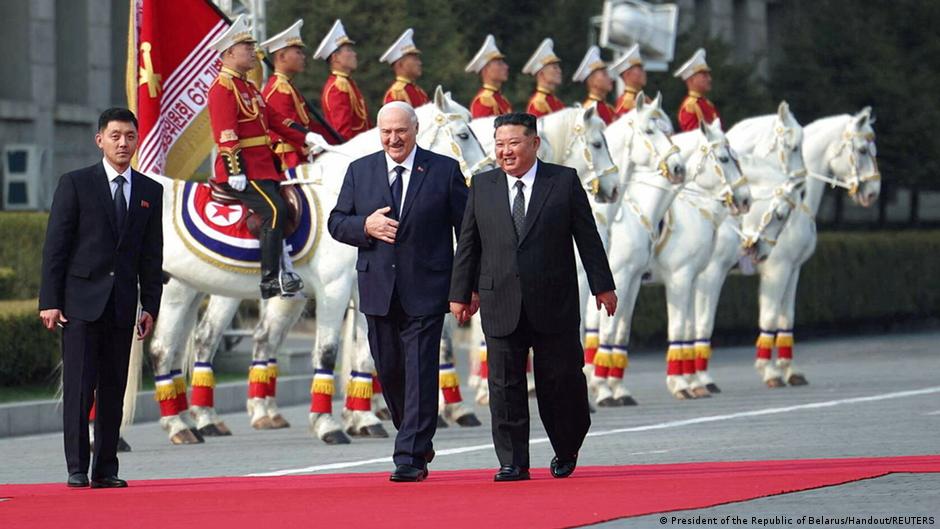
North Korea hosted Belarusian President Alexander Lukashenko in Pyongyang and the two sides said they will sign a friendship and cooperation treaty during the two-day visit, potentially expanding trade in food and pharmaceuticals. Both countries' support for Russia's war effort and mutual isolation under sanctions increases geopolitical risk, raising the likelihood of greater scrutiny and sanction-related pressure on defense suppliers, sanction-exposed trade corridors and related commodity flows.
This visit accelerates integration among sanction-constrained states into a parallel trade and logistics ecosystem — expect a measurable shift of certain commodity and munitions flows into opaque third‑country corridors over 3–18 months. Mechanically, that raises war‑risk premiums on affected sea lanes and insurance surcharges (war‑risk can surge 2–10x for specific voyages), increases freight forwarder margin capture, and benefits intermediaries in Turkey/UAE/China that provide transshipment, re‑labeling, or barter settlement services.
On the demand side, durability of Russian ammunition supply chains improves if alternative suppliers and routing mature, extending conflict tail risks and keeping European defense procurement elevated through 2026–2028; a 10–15% uplist in NATO procurement commitments would translate to asymmetric upside for precision‑munitions and C4ISR suppliers versus broad industrials. Financially, extended sanction circumvention raises counterparty and correspondent‑bank credit risk for a subset of EM and European lenders over the next 6–12 months, and increases operational revenue for compliance/AML vendors that can charge premium renewals and on‑boarding fees.
Primary reversal catalysts are enforceable secondary sanctions, a China‑led tightening of re‑exports, or pragmatic US diplomatic outreach that opens credible pathways for normalization — any of which could compress premiums and unwind the nascent parallel ecosystem within quarters. Investors should treat this as a slow‑building structural reallocative event, not a one‑day headline; position sizing should reflect asymmetric policy tail risk and step‑in over 3–12 month tranches.
AI-powered research, real-time alerts, and portfolio analytics for institutional investors.
Overall Sentiment
mildly negative
Sentiment Score
-0.25
