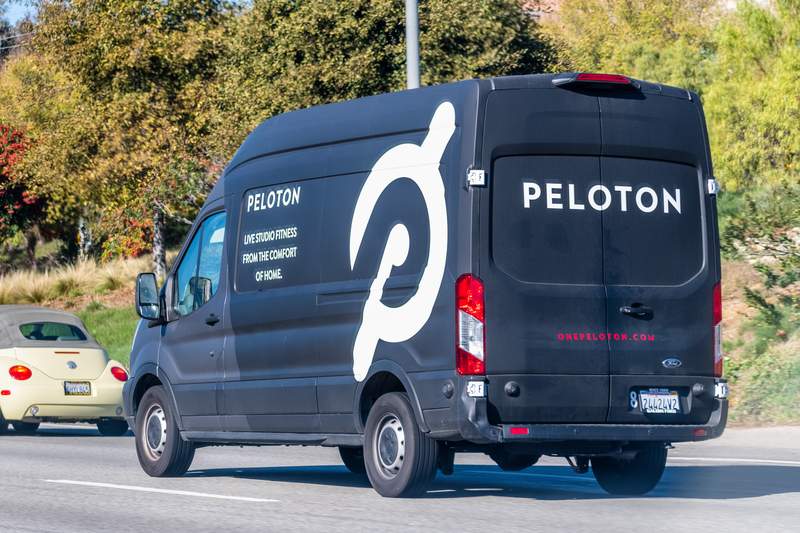
Peloton reported mixed Q3 results, with revenue of $631 million beating the $618.74 million consensus while adjusted EPS of $0.06 missed estimates by $0.01. The company raised fiscal 2026 revenue guidance to $2.42-2.44 billion and lifted free cash flow target to about $350 million, while adjusted EBITDA guidance stayed unchanged at $470-480 million. Shares rose 4.23% pre-market as investors focused on stronger financial metrics, including $151 million in free cash flow and net debt down 70% year over year to $173 million.
The market is likely rewarding the quality of the beat more than the size of the beat: Peloton is no longer being valued as a pure demand-recovery story, but as a cash-generation story with optionality. The key second-order signal is that management is extending the runway without needing heroic top-line acceleration, which compresses bankruptcy/financing risk and should lower the equity risk premium versus other consumer hardware names still burning cash.
The more important implication is competitive rather than absolute: if connected fitness demand is stable enough to support positive FCF while lowering leverage, Peloton can keep investing in software, content, and ecosystem retention without tapping capital markets. That pressures smaller at-home fitness and equipment peers that depend on discounting or external funding, and it may also force legacy gym-adjacent brands to compete harder on bundled subscriptions rather than hardware margin alone.
The near-term risk is that this is a sentiment-friendly quarter in a category that still lacks obvious unit-growth reacceleration. A few months of strong cash flow can mask that subscriber count is still contracting, so the setup is vulnerable if the next two quarters show guide-up fatigue or if hardware demand normalizes after any pull-forward. The longer-term question is whether the raised free-cash-flow target is a durable base or just a cyclical peak from cost discipline; if it is the latter, the multiple should stop expanding quickly.
Consensus may be underestimating how much balance-sheet repair changes the equity math. With net debt trending lower and cash conversion improving, Peloton can survive a prolonged revenue plateau, which makes the stock more sensitive to operating leverage upside than to near-term EPS misses. That argues for treating dips as tradable only if the company continues to convert revenue into debt reduction over the next 2-3 quarters.
AI-powered research, real-time alerts, and portfolio analytics for institutional investors.
Request DemoOverall Sentiment
moderately positive
Sentiment Score
0.55
Ticker Sentiment
