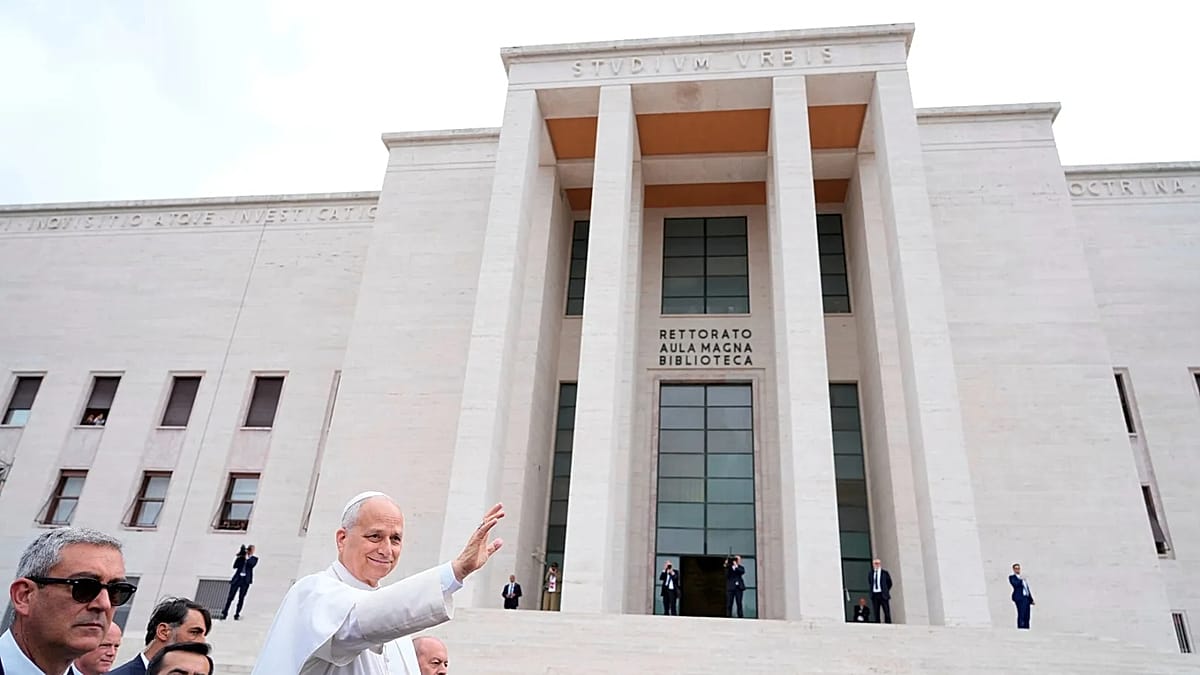
Pope Leo XIV warned that AI and high-tech weaponry are contributing to a "spiral of annihilation," while calling for stronger monitoring of AI in both military and civilian uses. He also criticized rising military spending, particularly in Europe, for diverting resources from education and healthcare amid conflicts in Ukraine, Gaza, Lebanon, and Iran. The remarks are important for the policy debate but are unlikely to have immediate market impact.
This is not an immediate trading catalyst for pure-play defense or AI hardware, but it is a meaningful narrative risk: moral scrutiny around AI is shifting from academic debate to institutional pressure, which can raise the cost of capital for vendors selling autonomous decision-support, targeting, surveillance, and dual-use compute. The second-order winner is likely compliance-heavy incumbents that can repackage products around human-in-the-loop, auditability, and governance, while the loser set is the smaller cohort of “move fast” AI names that depend on opaque model deployment and defense-adjacent commercialization. The more tradable angle is procurement and policy lag. In the next 3-12 months, Europe is the likeliest venue for tighter procurement standards and NGO/media pressure, which could slow deal conversion for firms exposed to public-sector AI, training data, or battlefield applications without broadening end-market diversification. That creates a relative-value opportunity: names with strong enterprise workflows and clear ROI should outperform names whose growth case depends on permissive regulation and ambiguous use cases. There is also a subtle allocation effect. If governments face stronger scrutiny over military AI spend, budgets may tilt away from frontier autonomous systems and toward defensive cyber, EW, secure communications, and non-controversial infrastructure upgrades. That is a better risk/reward area than headline drone/autonomy exposure because it benefits from the same geopolitical backdrop without the reputational overhang. The contrarian view is that this may be mostly tone, not policy. Unless the Vatican line is quickly amplified by regulators, procurement agencies, or pension allocators, the direct earnings impact on listed AI companies is likely de minimis over the next quarter. The real market risk is not a sudden selloff, but a slower multiple compression for the most controversial AI beneficiaries as ESG and governance screens become harder to ignore.
AI-powered research, real-time alerts, and portfolio analytics for institutional investors.
Request DemoOverall Sentiment
mildly negative
Sentiment Score
-0.20
