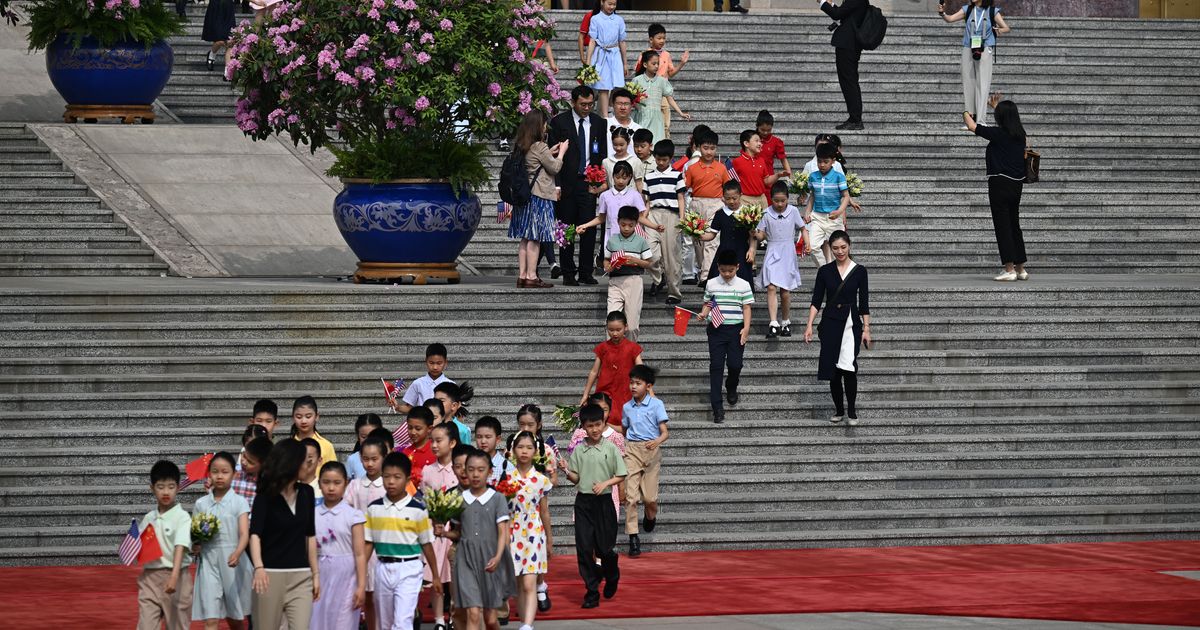
Xi Jinping warned Trump that mishandling Taiwan could cause a clash and create an “extremely dangerous situation,” underscoring a major geopolitical risk at the first U.S. presidential visit to China in nearly a decade. The summit is centered on Taiwan, trade, export controls and the Iran war, with little sign of a major breakthrough; China is also seeking relief from U.S. pressure on Taiwan arms sales and technology restrictions. Chinese customs data showed Beijing approved beef export licenses for several hundred U.S. slaughterhouses, but the broader tone remains tense and could affect markets tied to tariffs, semiconductors and defense.
The market implication is less about any headline breakthrough and more about what is now being priced as an extended negotiation regime. That favors companies with China exposure that can tolerate policy uncertainty, while penalizing names whose valuation embeds smooth export-control relief or uninterrupted China demand expansion. For semis, the key second-order effect is that any rhetorical de-escalation can temporarily compress implied volatility, but it does not remove the structural premium being demanded for supply-chain redundancy, so rallies in the most China-sensitive hardware names should be sold into rather than chased. Nvidia is the cleaner expression of this asymmetry: even modest easing around export constraints would help sentiment, but the strategic issue is that Beijing has now signaled it will keep linking market access, rare-earth leverage, and Taiwan-related pressure in one package. That means NVDA’s China optionality remains a low-confidence upside case with a high headline beta, while domestic AI capex and sovereign demand remain the more durable drivers. Apple faces a different risk profile: it is less about direct restrictions and more about a gradual increase in bargaining friction over market access, local regulatory treatment, and consumer nationalism, which can shave China unit growth without triggering a single discrete event. The biggest tail risk is not an immediate tariff escalation but a misread of the summit as durable détente, leading to complacency in vol and underhedging into a period where any Taiwan- or Iran-related shock could reprice across semis, industrials, and supply-chain proxies within days. The contrarian read is that the market may be overestimating how much Beijing needs to concede on trade; Xi’s stronger bargaining chip is geopolitical, not economic, so the path of least resistance is symbolic concessions and tactical delays, not structural liberalization. That argues for treating any relief rally as a short-duration trade, with a three- to six-month window for policy headlines to disappoint.
AI-powered research, real-time alerts, and portfolio analytics for institutional investors.
Request DemoOverall Sentiment
moderately negative
Sentiment Score
-0.35
Ticker Sentiment
