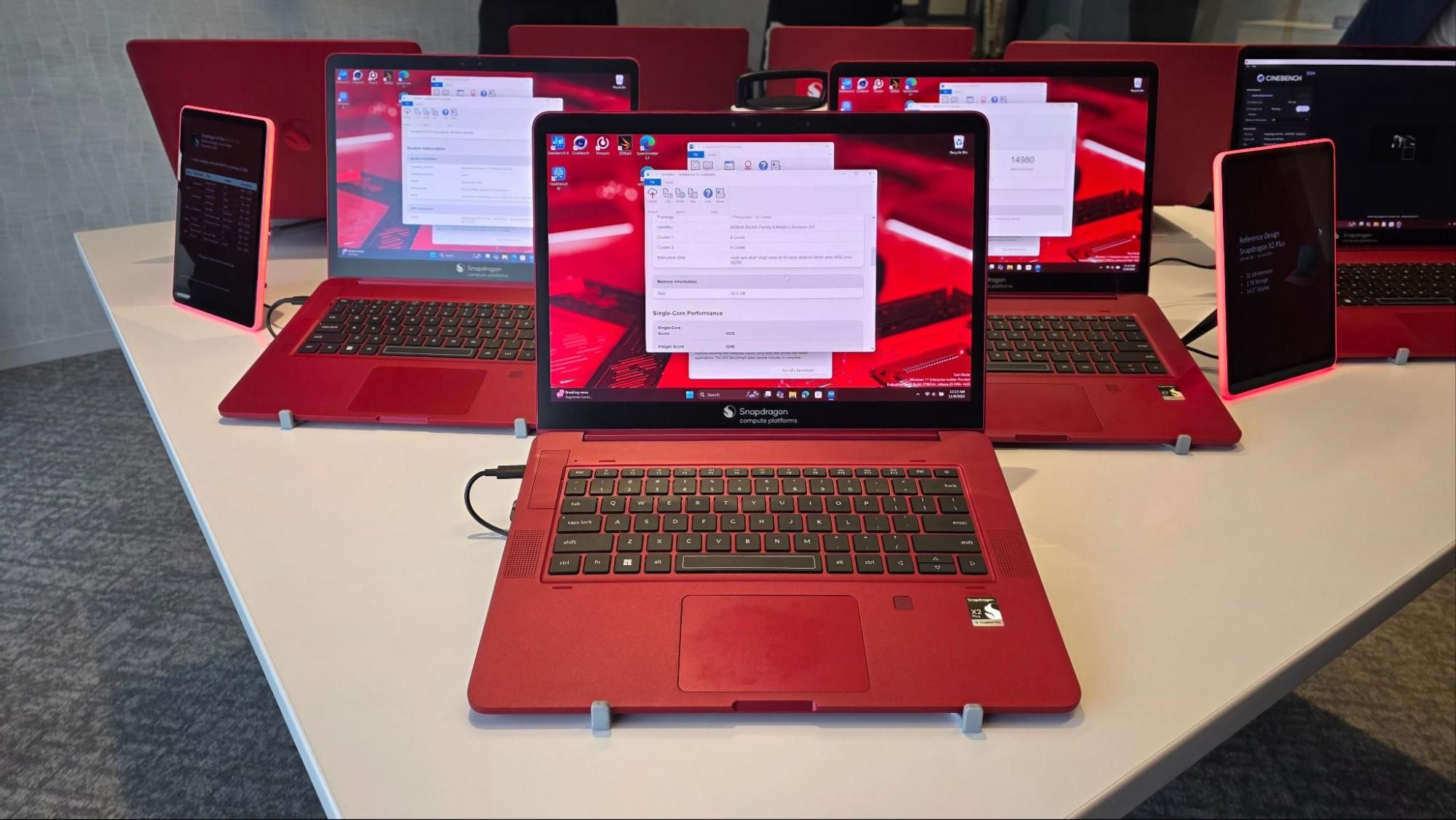
Qualcomm announced the Snapdragon X2 Plus family at CES 2026, debuting two SKUs: the X2P-64-100 (10 cores: 6 Prime + 4 Performance, boost to ~4.04GHz) and the X2P-42-100 (6 Prime cores, boost to ~4.04GHz). Qualcomm claims a 35% single-core and 17% multi-core Geekbench 6 uplift for the X2P-64-100 versus last-gen X1P-64-100, reference Geekbench 6.5 results of 3,323 (single) and 15,084 (multi), an updated Adreno X2-45 GPU (1.7GHz / 0.9GHz), an 80 TOPS Hexagon NPU, up to 128GB LPDDR5X @ 9,523 MT/s, and TSMC N3P process. Qualcomm also provided competitive comparisons versus Intel Core Ultra 7 265U (claims of multix gains at ISO power and double-digit % headroom at peak), and expects X2 Plus to appear in select OEM devices in H1 2026 — a modestly positive development for Qualcomm and ARM-based Windows OEMs but unlikely to be immediately market-moving on its own.
Market structure: Qualcomm (QCOM) and TSMC (TSM) are direct beneficiaries — QCOM gains pricing/pipeline leverage in Windows ARM laptops and NPU-enabled devices while TSM collects higher-margin N3P wafer demand and LPDDR5X packaging volume. OEMs like HP (HPQ) that adopt X2 Plus can differentiate on battery/perf; Intel (INTC) and, to a lesser extent, AMD (AMD) face renewed share pressure in low-power Windows SKUs and potential pricing compression in the ultra-mobile segment. Macro signals: stronger demand for N3P capacity and LPDDR5X implies tighter foundry and memory supply into H1–H2 2026, supporting TSM/TW semiconductor supply chain spreads and modestly boosting capex visibility for fabs.
Risk assessment: Tail risks include antitrust/patent litigation (historical for QCOM), a software-ecosystem stall (Windows drivers, emulation losses), or TSMC N3P allocation shortfalls; any of these could wipe >20% off near-term upside. Time horizons: expect immediate CES-driven sentiment lift (days–weeks), product placements and OEM reviews to matter over H1 2026 (weeks–months), and material share-shift outcomes over 12–36 months. Hidden dependencies: Microsoft OEM support, app optimization for ARM, and potential exclusivity clauses or third-party entrant (MediaTek/NVIDIA) announcements are second-order determiners. Key catalysts: OEM launch cadence (next 90 days), independent benchmarks (next 3–6 months), and TSMC capacity commentary at earnings.
Trade implications: Favor tactical longs in QCOM and TSM while hedging execution risk — QCOM/TSM are primary longs; INTC is a tactical short candidate in the ultra-mobile laptop cohort. Use options to define risk: 9–15 month QCOM call spreads to target 20–40% upside; buy protection or short near-term calls on INTC if initiating the pair. Sector rotation: shift 2–4% portfolio weight from legacy PC suppliers/Intel exposure into semiconductor foundry (TSM), IP/SoC (QCOM), and selective OEMs (HPQ) ahead of H1 2026 placements.
Contrarian view: The market may overstate near-term ARM wins — software/emulation and gaming limitations could slow adoption, capping QCOM outperformance if benchmarks underdeliver; conversely TSM may be underpriced for N3P demand, so foundry exposure could outperform QCOM if QCOM faces litigation or OEM slowdowns. Historical parallel: previous Windows-on-ARM cycles showed hardware gains but ecosystem lag; hedge conviction positions and take profits on any >30% rally pre-Windows/driver validation. Unintended consequence: accelerated competition (MediaTek/NVIDIA/AMD) could compress QCOM margins within 18–36 months, so scale positions accordingly.
AI-powered research, real-time alerts, and portfolio analytics for institutional investors.
Request DemoOverall Sentiment
mildly positive
Sentiment Score
0.25
Ticker Sentiment
